
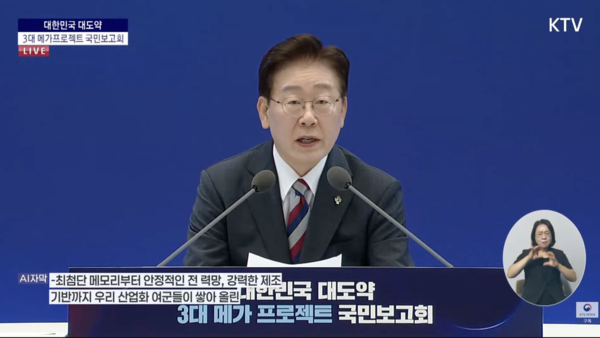
President Lee Jae Myung (이재명) chaired a public briefing at Cheong Wa Dae on Sunday on South Korea's three mega projects and outlined a Korea-style artificial intelligence industrial revolution plan centred on semiconductors, physical AI and AI data centres. Lee said, "Only a speed war is a way to live," and stressed he would pre-emptively secure overwhelming supply capacity by making large-scale investments in new hubs, including the southwest.
The briefing, held under the slogan "Beyond recovery to a major leap, ultra-gap South Korea," was attended by Samsung Electronics Chairman Lee Jae-yong (이재용) and SK Group Chairman Chey Tae-won (최태원). Jun Young-hyun (전영현), a vice chairman at Samsung Electronics and head of its DS division, and Kwak Noh-jung (곽노정), CEO of SK Hynix, also attended along with other semiconductor leaders. About 100 people joined, including executives from companies and related institutions in the three mega project fields such as LG Electronics, Furiosa, Robotis, HD Hyundai Robotics, GS, KT, Korea Electric Power Corp and Korea Water Resources Corp, as well as government officials.
In his opening remarks, Lee presented a major leap into becoming an ultra-gap industrial powerhouse as a key task. "We must secure overwhelming competitiveness in cutting-edge technology fields such as semiconductors and artificial intelligence, and make sure the fruits of growth can spread evenly to all people across the country," he said. He also said the event was the first starting point for carrying out a heavy task.
Lee defined the current situation as "a decisive time when the global economic landscape is shaking." He said major countries such as the United States and China are waging a national rivalry that combines astronomical investment with government support to seize the new continent of artificial intelligence. He also defined semiconductors for computing and inference, AI data centres for processing data and physical AI that realises artificial intelligence in the real world as "the triangular axis for a major leap." He said government and private sector capabilities must be fully mobilised to tie them together and build a Korea-style AI ecosystem.
◆"Yongin, Pyeongtaek at their limits... develop new sites in the southwest"
Lee made clear the limits of existing production bases. "Sites centred on Yongin and Pyeongtaek are already reaching their limits," he said, citing shortages of electricity and water. He said planned sites should be completed quickly while also "moving up the speed significantly" to secure new regions with electricity and water as well as cheap and stable land.
Lee also stressed the importance of a regional strategy. He said that as a crisis of regional extinction has deepened due to policies that concentrated on the Seoul metropolitan area during the industrialisation period, the fact that the Honam region was long excluded from development has instead become an opportunity factor. "The southwest coastal area is where water is abundant and, in particular, renewable energy is abundant," Lee said, explaining why companies chose the region as a base. He also said the announcement has special significance because balanced development aligns with demand for new semiconductor hubs.
He also made clear he would not premise the plan on imposing burdens on companies. "We will not push through national needs while forcing losses and risks on companies. We will invest government capabilities on a large scale so companies can invest without losing money and with a better outlook," Lee said. It was reported that the Gwangju and South Jeolla region has put forward a position that it can invest 5 trillion to 20 trillion won in integrated support funds.
Lee promised to place a directly supervised officer in charge of the three mega projects inside Cheong Wa Dae and oversee the projects himself. "The results of the three mega projects will be responsible for South Korea's next 20 and 30 years," Lee said, adding, "I will not shy away from any innovation needed, starting with newly reorganising policies and laws."
Samsung and SK, meanwhile, are signalling their largest-ever local investment by mobilising groupwide capabilities, and an investment scale exceeding 1,000 trillion won over 10 years is being discussed for building a semiconductor belt in the Honam region.
 Seok Dae-geon
d2dg@d-today.co.kr
Seok Dae-geon
d2dg@d-today.co.kr