
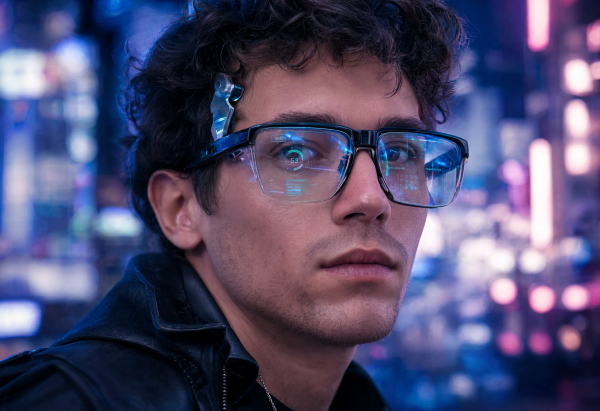
As advanced technologies such as brain-computer interfaces (BCI), AI smart glasses and robotic prosthetic hands rapidly become reality, some assessments say the future envisioned by the science fiction genre “cyberpunk” is partly becoming real in industry and society. The analysis says the most accurate prediction was not flashy body modification technology, but the power structure of big technology companies that dominate digital space.
According to blockchain media outlet Decrypt on June 28 (local time), the future depicted by cyberpunk is taking on new meaning as the era of AI and digital platforms arrives.
Cyberpunk has long portrayed a future society where big corporations and hackers, artificial intelligence (AI), virtual reality (VR) and body augmentation technologies coexist. Today, brain-computer interfaces such as Elon Musk’s Neuralink, AI-based smart glasses and sophisticated robotic prosthetic hands have emerged. OpenAI, xAI, Anthropic, Meta and Google have grown into platform companies that influence how billions of people work and communicate.
Ken Goffman, a prominent figure in early internet culture, recalled that there were high expectations that the internet would disperse the power of governments and large corporations. But reality was different. “Rather than dispersing power, the companies that made the technology became the most powerful institutions in the world,” he said.
Goffman said that at the time even dystopian imagination felt like a kind of play, but the real future arrived in a far less dramatic and more everyday form. “Even the apocalypse is not interesting like a movie. It is very boring and ordinary,” he said.
He also pointed to changes in internet culture. He said he used to work under the pen name “R.U. Sirius,” but returned to using his real name as real-name platforms such as Facebook emerged, and that it felt like the moment the era of internet anonymity began to end.
Another analysis said cyberpunk’s most accurate prediction was the power structure rather than the technology. Shira Chess, a professor of entertainment and media studies at the University of Georgia, said, “The core of cyberpunk is not cyber prosthetic arms or smart glasses, but that it foresaw a future in which corporations dominate digital space.”
She said the control structure and social discourse surrounding AI are more important issues than AI itself. She said that the more society accepts AI only in certain ways, the harder it may become for future generations to imagine other possibilities.
The internet environment is also being assessed as shifting from open to closed. While the internet itself remains accessible to anyone, AI services and software are increasingly moving into subscription models and closed ecosystems.
Chess also voiced concern about the spread of AI coding assistants. She said there is a growing possibility that developers will rely on AI rather than directly understanding systems, and stressed that to build technology that is not dependent on companies, people ultimately need to understand programming and system structures on their own.
At the same time, movements pushing back are also emerging. “Cyberdeck” culture, in which people build computers themselves using recycled hardware and open-source software, is spreading. Open-source developers and privacy activists are continuing efforts to respond to an AI ecosystem that is becoming increasingly closed.
In some areas, opposition to building AI data centres is also continuing. Community movements opposing new data centres are spreading, citing water use, power consumption and environmental burdens.
Cryptocurrency and blockchain were also linked to cyberpunk values. Project Spartacus used the bitcoin network to permanently preserve WikiLeaks’ Afghanistan war logs, and it was also confirmed that in 2023 a copy of the bitcoin white paper was included inside Apple’s macOS operating system. The assessment says the approach of pushing back against government and corporate power through code and decentralised networks aligns with the worldview cyberpunk portrayed.
Still, cases have emerged in which hostility toward technology companies spills over into real-world conflict. In April, a suspect was arrested on charges of throwing a Molotov cocktail at the home of OpenAI CEO Sam Altman and threatening OpenAI headquarters.
Chess pointed to Generation Z and Generation Alpha as the generations that will drive future change. She said they have a much more complex view of the technologies they encountered while growing up than previous generations.
Ultimately, the most important message left by cyberpunk was not what future technology looks like, but the question of who controls that technology and for whom it is used. With AI and platform companies expanding their influence across society, the issue of power and control raised by cyberpunk is no longer imagination in a novel but a task to be confronted directly in real-world industry and the digital ecosystem.
 Jinju Hong
hongjj@d-today.co.kr
Jinju Hong
hongjj@d-today.co.kr