
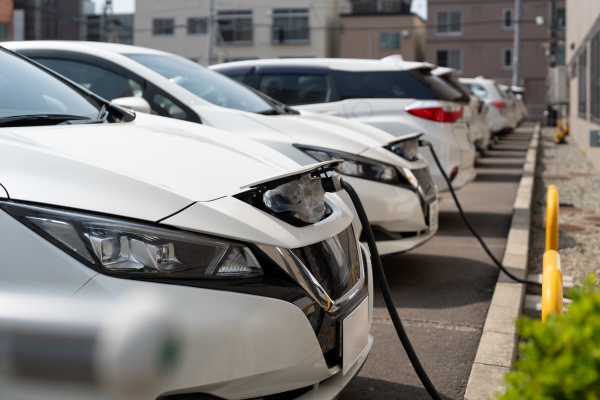
In China’s auto market, plug-in vehicles are forecast to account for more than 90 percent of sales by 2030. Analysts also expect most of the new-energy vehicle (electric vehicle) market to be taken by pure battery electric vehicles (BEVs), drawing attention to the pace of electrification in the world’s largest car market.
Cleantechnica, an electric-vehicle outlet, reported on Friday that Nio CEO and chairman William Li (리빈) said at the “2026 Nio Partner Day” event that more than 90 percent of car sales in China would be plug-in vehicles by 2030. He also forecast that pure electric vehicles would be central even within the new-energy vehicle market.
He predicted that pure electric vehicles would account for about 90 percent of China’s new-energy vehicle market in 2030. That would mean BEVs become the mainstream, beyond the expansion of new-energy vehicles that include plug-in hybrids (PHEVs).
The outlook also aligns with recent sales trends in China. Last month, plug-in vehicles already accounted for 63 percent of sales in China’s auto market. With the share well above half, the forecast is that it will top 90 percent within the next 5 years.
China is also the world’s largest auto market. Last year, China sold 34.35 million vehicles, about 35.6 percent of global sales of 96.47 million. That is why shifts in China’s market inevitably affect the entire global auto industry.
Nio cited technological progress as a backdrop to the transition. Li explained that rapid advances in full-stack BEV technology, charging infrastructure, battery-swap systems and energy supply frameworks are accelerating electric-vehicle adoption.
Nio is maintaining a strategy of selling only pure electric vehicles. That contrasts with recent moves by Chinese automakers to expand plug-in hybrid lineups. The company plans to further strengthen its pure EV competitiveness based on its charging and battery-swap infrastructure.
It is also strengthening product competitiveness. The Onvo L60, the first model of Nio’s Onvo brand, has topped cumulative deliveries of 100,000 units since its launch in September last year.
Earlier this month, it unveiled a facelifted model. The new L60 cut prices by about 7 percent from the previous version and was launched in three trims: Pro, Max+ and Ultra+. The standard purchase price starts at 192,800 yuan, and the starting price can be lowered to 135,800 yuan by using its battery subscription service (BaaS).
The biggest change is the autonomous-driving semiconductor. Nio installed its in-house 5-nanometre automotive smart driving chip, the Shenji NX9031, on the Max+ and Ultra+ trims. Combined with Nio’s world model architecture, the chip supports a navigation-based driver assistance feature that automatically drives to a destination.
Nio has also started selecting a host city for its annual “Nio Day 2026” event. Car-owner clubs in each city will propose candidate cities, and after screening, the final three candidates will be chosen. Nio plans to decide the venue through a vote by members of the Nio community.
Candidate cities must meet certain standards. They must not have hosted Nio Day in the past 8 years and must have an outdoor space of at least 25,000 square metres and a venue capable of accommodating at least 8,000 people.
The announcement is being assessed as showing Nio’s long-term strategy beyond a simple sales forecast. The company presented expanded pure electric vehicles, battery-swap infrastructure and in-house semiconductor development as its core competitiveness, and forecast that China’s EV market will be rapidly reshaped around pure electric vehicles. As the likelihood grows that electrification in China, the world’s largest auto market, will accelerate faster than expected, attention is also turning to how global automakers will respond.
 Jinju Hong
hongjj@d-today.co.kr
Jinju Hong
hongjj@d-today.co.kr