
[Digital Today reporter Yoonseo Lee] As discussions in the U.S. Congress over the Clarity bill progress, crypto application tokens that generate actual fee revenue are being put up for reassessment.
On June 26 (local time), blockchain media outlet CryptoSlate reported that asset manager Grayscale sees tokens linked to on-chain financial services such as trading, lending and staking as potential beneficiaries if a federal-level regulatory framework is established.
The key is easing regulatory uncertainty. The Clarity bill includes provisions that specify regulatory responsibility for digital assets and companies that trade them. Supporters of the bill believe traditional financial institutions such as banks and asset managers could have greater confidence in operating on public blockchains. Grayscale also pointed to applications that already process trades and collect fees as direct candidates to benefit from such changes.
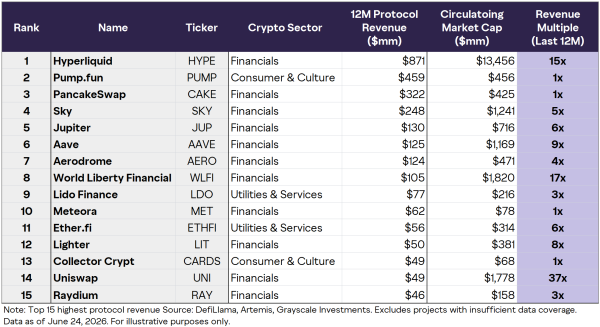
In trading, Hyperliquid was named the most promising candidate. Hyperliquid recorded $871 million in protocol revenue over the 12 months through June 24. That was the largest among those tracked. HYPE's circulating market capitalisation was about $13.46 billion, valuing it at about 15 times revenue over the past year. The valuation is high, but Hyperliquid generated almost twice as much revenue as its closest competitor.
In this setup, PancakeSwap, Jupiter, Aerodrome and Raydium were also mentioned as candidates for gains. PancakeSwap posted $322 million in revenue over the past 12 months, but the CAKE token's circulating value was $425 million, about 1 times protocol revenue. Jupiter had $130 million in revenue and a circulating market capitalisation of $716 million, about 6 times, while Aerodrome was about 4 times on $124 million in revenue. Meteora generated $62 million in revenue, but its valuation stayed at $78 million. Raydium also had a circulating market capitalisation of $158 million on $46 million in revenue, about 3 times.
Uniswap, by contrast, showed a different picture. Uniswap generated $49 million in protocol revenue, but UNI's circulating market capitalisation was about $1.78 billion. At 37 times revenue, it was the highest multiple among the 15 protocols tracked by Grayscale. Still, if regulatory clarity does not lead to a sharp rise in activity, room for a valuation rebound could be limited versus lower-multiple rivals.
Solana-based memecoin issuance platform Pump.fun also ranked near the top. The Pump.fun token recorded $459 million in annual protocol revenue and had a circulating market capitalisation of $456 million. The valuation is read as reflecting doubts over whether activity tied to speculative token issuance can persist through shifts in market cycles.
Lending protocols were also cited as potential beneficiaries. Aave recorded $125 million in revenue over the past 12 months, and the AAVE token's price-to-earnings ratio was about $1.17 billion, around 9 times. If regulated stablecoins, tokenised funds and blockchain-based securities increase, the pool of collateral assets could broaden and borrowing and lending demand could rise. If banks and asset managers enter public blockchains, they will need not only exchanges but also credit markets, collateral management systems and liquidity-provision infrastructure.
Sky was also presented as a potential beneficiary. Sky, previously known as Maker, generated $248 million in revenue over the past year and ranked fourth in the tally. SKY's circulating market capitalisation was about $1.24 billion, about 5 times revenue. It was cited as having high exposure to stablecoins and real-world asset (RWA) tokenisation, linking it directly to financial activity the bill is expected to encourage.
World Liberty Financial (WLFI), backed by U.S. President Donald Trump, also generated $105 million in revenue over the past 12 months. The WLFI token's valuation was about $1.82 billion, 17 times revenue. This shows the market is pricing in value beyond current fee income.
Staking and infrastructure may also see indirect benefits. Lido Finance recorded $77 million in revenue over the past 12 months, and LDO's circulating value was $216 million. At about 3 times revenue, it was relatively low. Ether.fi posted $56 million in revenue over the same period and had a circulating market capitalisation of $314 million, about 6 times. If the bill draws more assets and transactions onto public networks, demand for blockchain security and yield products could also increase. Still, staking has separate legal issues remaining, so the final bill may not resolve all problems.
Another point Grayscale highlighted was that valuation burdens are not large. Of the 15 protocols tracked, 12 trade at single-digit multiples of revenue over the past year. Pump.fun, PancakeSwap, Meteora and Collector Crypt were around 1 times, while Lido and Raydium were about 3 times and Aerodrome was 4 times. Sky, Jupiter and Ether.fi were 5 to 6 times, Lighter was about 8 times and Aave was about 9 times.
A variable is that revenue and token value are not directly linked. Protocol fees can be distributed among validators, liquidity providers, developers, protocol treasuries and users. If token supply is locked and later released, it is difficult to judge final value based only on circulating market capitalisation. This means projects with mechanisms that connect economic value to tokens, such as fee distribution, token buybacks, staking demand and governance rights, may be better positioned alongside revenue growth.
The Clarity bill does not guarantee price gains for all tokens. It may, however, reduce regulatory discount factors attached to crypto projects targeting the U.S. market and lower barriers that have blocked participation by institutional funds.
 Yoonseo Lee
yslee@d-today.co.kr
Yoonseo Lee
yslee@d-today.co.kr