
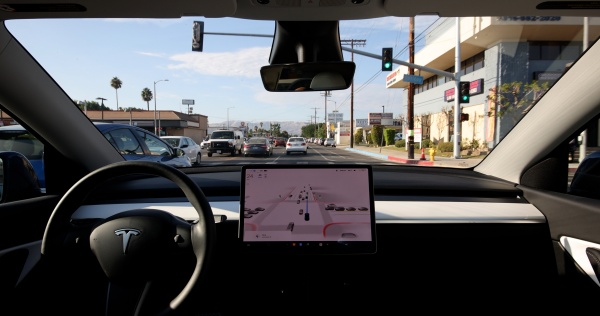
Tesla has stopped selling a perpetual Full Self-Driving (FSD) licence and shifted to a $99-a-month subscription model, with users saying vehicles with the latest hardware (HW4) feel worth more than the fee. Users of older HW3 vehicles, however, have continued to complain that they cannot properly use the latest functions.
On June 26, electric-vehicle outlet CleanTechnica introduced the experience of a user who drove both a 2019 Tesla Model 3 and a 2026 Model Y. It reported that the perceived performance of FSD differs sharply depending on the vehicle’s hardware generation.
Tesla recently ended sales of a perpetual FSD licence and began offering only the $99-a-month subscription. In the past, the price of FSD started at $6,000 and rose as high as $10,000 at one point before being adjusted to $8,000.
The user said they paid $6,000 to buy FSD permanently when purchasing a 2019 Model 3. Divided by about 78 months of vehicle ownership, that amounts to an average of about $77 a month. Based on the current price of $8,000, the user calculated that the vehicle would need to be kept for more than about 6.5 years to be more cost-effective than the $99-a-month subscription.
But the bigger difference than cost was hardware performance. Tesla began applying the HW4 platform to newer vehicles from 2023, including a more powerful computer, improved cameras and a front bumper camera. As major FSD updates have since been centred on HW4, HW3 vehicles have effectively remained on FSD V12, while newer vehicles can use FSD V14.
After the user’s Model 3 was declared a total loss, the user used a rental car for about three weeks and then bought a 2026 Model Y that included a 30-day free trial of FSD V14, making a direct comparison. The user assessed HW4-based FSD V14 as having "taken driving automation to a new level." The user said it moves a little more cautiously than a person at stop signs, but travelled stably to the destination with little need to touch the brake or accelerator pedal or the steering wheel.
The user also said driving quality improved sharply. It kept an appropriate speed on roads with unclear lane markings or sharp curves, and recognised pedestrians approaching crosswalks in advance to wait. It also slowed down and braked when a deer crossed the road, the user said.
Start and parking functions also improved. The vehicle backed itself out of a garage and performed reverse parking at large shopping mall car parks and at Tesla Superchargers, the user said.
The user also said it is not yet at a fully self-driving level. "Because the vehicle sometimes makes mistakes, driver supervision is still necessary," the user said. The user also pointed out that it often failed to park fully inside the garage after arriving, or parked farther away than where the driver would choose at large stores. Reverse-parking performance also worsened when a bike rack was installed on the rear of the vehicle.
The user also raised dissatisfaction with the pricing policy. The user pointed out that some Model S and Model X vehicles previously allowed steering assist by default during long-distance highway driving, but now the function cannot be used without subscribing for $99 a month, calling it "like a kind of threat."
The user also cited an advantage that drivers who do not often take long trips can reduce the burden by subscribing only in months when needed.
The report said the value of a $99-a-month subscription fee is not the same for all users. It said drivers who prefer to drive themselves may not see much need, while satisfaction may be higher for consumers seeking to reduce the burden of long-distance travel or actively use the latest driver-assistance functions.
The user forecast that if Tesla implements true Level 4 autonomous driving in the future, the current $99-a-month FSD subscription fee could also be raised further.
 Jinju Hong
hongjj@d-today.co.kr
Jinju Hong
hongjj@d-today.co.kr