
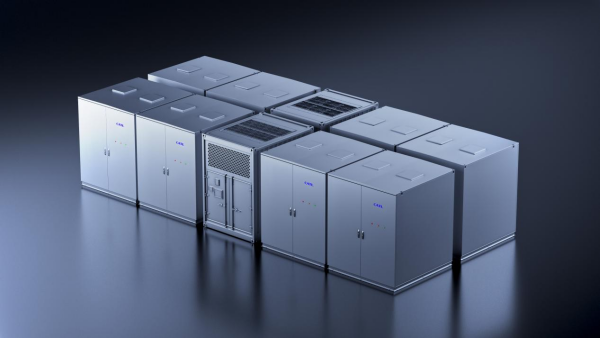
[DigitalToday reporter Jinju Hong] CATL, the world's largest battery company, unveiled a sodium-ion battery-based energy storage system (BESS) and presented a commercial supply schedule. Sodium-ion batteries, which had remained in the research and development stage, are now entering the large-scale energy storage market. This is expected to bring changes to a market structure centered on lithium-ion batteries.
On June 27 local time, EV publication CleanTechnica reported that CATL unveiled its sodium-ion energy storage system, Tener Sodium, at an event in Munich, Germany. The company said it has secured its technology, production capacity and supply chain and has completed preparations for commercialization.
CATL plans to begin first deliveries to customers in China in September and to ship a cumulative 1 GWh by the end of 2026. It also disclosed that supply to global markets will start from June 2027.
CATL assessed that the spread of AI data centers and the expansion of renewable energy are turning energy storage systems from simple auxiliary facilities into core power infrastructure. But it said the current market is overly dependent on lithium-based batteries, increasing risks from raw material price fluctuations and supply chains, and it presented sodium-ion batteries as a new alternative.
William Wu (윌리엄 우), director of CATL's Energy Storage Technology Center, said, "We have been developing a new battery chemistry system based on resources that can be abundantly secured on every continent." He said, "Lithium and sodium will become the two pillars of the energy storage market."
The product is a large energy storage system providing a rated capacity of more than 30 MWh. It adopts a fully modular structure and is designed so that building a 1 GWh storage site requires placing only 34 modules weighing about 42 tons each. It also separates power and energy blocks, allowing storage duration to be configured freely from 1 hour to 8 hours depending on a project's purpose.
It also improved maintenance efficiency. The company said only failed modules can be independently isolated and replaced, reducing downtime and cutting maintenance costs.
Technical improvements were also made. CATL applied a new dedicated bidirectional voltage regulation system to respond to the wide voltage range of sodium-ion batteries. It said this increased round-trip efficiency by about 2 percent and, based on a 1 GWh storage site, can be expected to produce the effect of additional power generation of several million kWh per year.
The battery management system (BMS) was also redesigned to match sodium-ion characteristics. It said it improved the accuracy of state-of-charge (SOC) estimation by using a continuously changing voltage curve and strengthened safety by expanding the allowable SOC range in overcharge situations by about 20 percent compared with lithium-ion batteries.
Reducing operating costs is also a key feature. By applying a top-exhaust airflow design, it reduced the heat island effect and lowered system heat generation by about 30 percent compared with existing methods. Combined with a liquid cooling system, it also cut auxiliary power consumption by about half, from an industry average of about 2 percent to around 1 percent. System noise was reduced to about 65 decibels, 10 decibels lower than existing facilities, making it easier to install near urban areas.
CATL also highlighted compatibility with existing lithium iron phosphate (LFP)-based storage systems. It said the system is designed to use the same installation area and platform while supporting both sodium-ion and lithium-ion batteries, allowing a switch in battery chemistry without changing enclosures, redesigning projects or undergoing certification procedures. The company said it expects the system can also be used as an alternative to respond to fluctuations in lithium prices.
Amanda Xu (아만다 쉬), CATL's ESS chief technology officer and president of its European ESS business, said, "The energy storage industry is now at a stage where competitiveness is determined not by a simple race for scale but by the ability to create long-term value." She said, "Prepared technology will reduce market uncertainty."
The commercialization is also the result of CATL's long-term investment. The company has conducted sodium-ion battery R&D since 2016 and invested about 1.2 billion euros over the past 10 years. About 300 R&D personnel participated, and it secured more than 1,600 patent families and more than 200 globally registered patents. It also built its own supply chain from materials to cell production and expanded cathode and anode material production capacity to tens of thousands of tons.
It has also already established a mass production system. CATL invested 5 billion yuan in its Fuding production base to add annual sodium-ion battery production capacity of 40 GWh, and it is also pushing to build a 160 GWh-a-year production base in Jining, Shandong province.
It also secured market demand. CATL signed a contract in April with energy storage company HyperStrong to supply a total of 60 GWh of sodium-ion energy storage systems over the next three years. The company assessed this as a signal that sodium-ion batteries have entered a full-scale GWh-level commercialization stage.
Following the product unveiling, sodium-ion batteries are expected to become a new option in the commercial energy storage market alongside lithium-ion batteries, moving beyond laboratory technology. CATL forecast that lithium and sodium will become the two main pillars leading next-generation energy storage infrastructure.
 Jinju Hong
hongjj@d-today.co.kr
Jinju Hong
hongjj@d-today.co.kr