
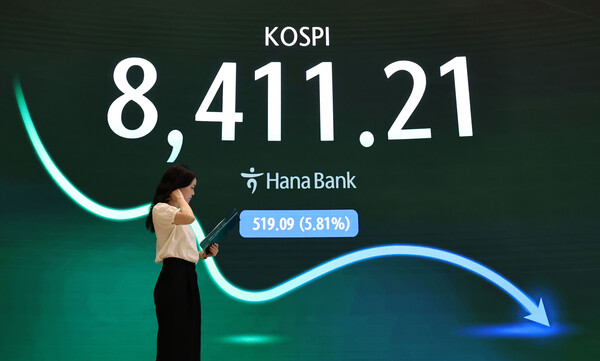
South Korean stocks this week are expected to digest the shock from last week’s sharp fall and check the direction of July trading.
South Korean stocks fell sharply on June 26. The KOSPI and Kosdaq plunged 5.8 percent and 4.1 percent, respectively. A circuit breaker was triggered on the KOSPI for the second time in a week.
Several negative factors overlapped, including Apple price hikes, reports that OpenAI’s initial public offering could be delayed, and uncertainty over the Strait of Hormuz. Still, markets largely view the selloff’s core as an unwinding of positions concentrated in semiconductors rather than a new major shock.
The recent rise in the KOSPI relied heavily on Samsung Electronics and SK Hynix. Their combined share of KOSPI market capitalisation exceeded half and expanded to close to 60 percent. That structure means the entire KOSPI has little choice but to move sharply if those two stocks wobble.
Supply and demand also overlapped from single-stock leveraged ETFs and passive products holding top market-cap stocks. That amplified selling pressure even on small negative news.
Volatility has increased further since single-stock leveraged ETFs were launched. This year’s average daily stock price volatility for Samsung Electronics and SK Hynix has expanded more after the products were launched than before.
Individual investor flows also concentrated not only in Samsung Electronics and SK Hynix but in single-stock leveraged ETFs based on those two stocks. Funds were drawn to products that offer leverage effects at lower prices than buying high-priced large-cap stocks directly.
In this process, the Kosdaq was relatively sidelined. Some momentum money that had previously gone to growth and small- and mid-cap stocks shifted to large semiconductor single-stock products. That is why the Kosdaq failed to keep up even when the KOSPI rose and was shaken together when the KOSPI fell.
Still, it is hard to say fundamentals have wavered. Strong semiconductor exports and rising memory prices have continued in June.
Profit estimates for the semiconductor sector are also being revised up gradually. The industry is watching the possibility that KOSPI earnings per share could be revised up again after second-quarter results are released.
The key to July trading is earnings. As the second-quarter reporting season begins, semiconductor profit outlooks centred on Samsung Electronics and SK Hynix will be checked again. If profit estimates rise, the recent sharp fall can be read as easing overheating.
If earnings expectations fall short of the market’s bar, the burden of the semiconductor-heavy rally could grow.
The high interest rate environment also needs to be considered. International oil prices have fallen back to pre-war levels, but U.S. 10-year Treasury yields remain high.
In a high-rate environment, funds tend to concentrate in companies with clear earnings momentum and improving profitability rather than all sectors rising together.
This week’s investment strategy appears to be to keep core semiconductor stocks while preparing for short-term swings. Leading sectors such as semiconductors, AI infrastructure and power equipment are likely to keep drawing market attention until earnings are confirmed.
But with daily swings widening due to leveraged ETF flows, a phased approach on pullbacks is needed rather than chasing prices higher.
Funds around the stock market remain abundant. Individual money continues to flow into domestic equity ETFs, and inflows centred on semiconductor ETFs are also continuing.
But if that money concentrates in some large-cap stocks and leveraged products, the gap could widen between index gains and what investors feel in the market. Next week, whether gains spread to more stocks is expected to be a more important yardstick than whether the index rebounds.
Ultimately, this week’s market is expected to be a stretch to recheck trust in semiconductor earnings after the sharp fall. If profit outlooks for Samsung Electronics and SK Hynix hold and supply-demand instability driven by leveraged ETFs eases, the KOSPI could try to rebound ahead of the July earnings season.
If volatility in large semiconductor stocks continues and Kosdaq flows fail to recover, the index is likely to repeat large swings.
Lee Jae-man (이재만), a researcher at Hana Securities, said, "Even now, considering maintaining high interest rate levels, selecting companies is important." He said companies should be selected based on stronger earnings momentum, maintaining forecasts for high earnings growth, and expectations of rising operating profit margins.
Noh Dong-gil (노동길), a researcher at Shinhan Investment Corp, said, "The stock market in July is a stretch where tightening vigilance and an upward turn in earnings revision upgrades confront each other." He said a strategy is needed to keep a core in semiconductors and AI infrastructure while re-entering on gap-driven pullbacks.
 Oh Sang-yup
yub@d-today.co.kr
Oh Sang-yup
yub@d-today.co.kr