
South Korea's Ministry of SMEs and Startups, the Defence Ministry and the Korea Aerospace Administration said on Thursday they will foster five new security companies with corporate values of 1 trillion won or more and 50 innovation firms with sales of at least 100 billion won by 2030.
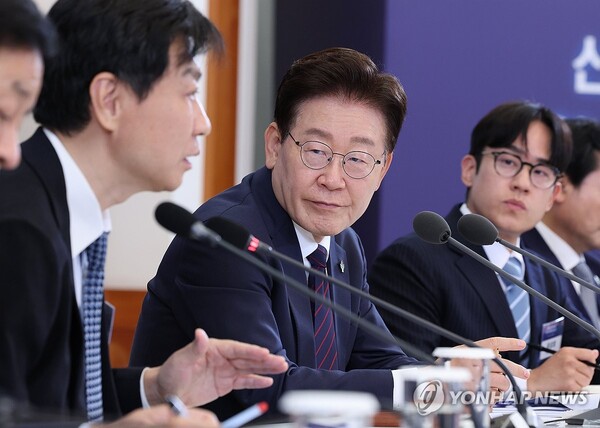
The three agencies held a "Future New Security Innovation Company Fostering Strategy" meeting at Cheong Wa Dae's Chungmu Room on Thursday with about 60 participants including officials from related ministries, small and medium-sized and mid-sized companies, and private-sector experts. They unveiled a policy direction to foster "K-Palantir" companies.
The government plans to designate drones and robots, defence artificial intelligence (AI) and semiconductors, defence sensors and future materials, space and aviation, and cyber security and quantum communications as strategic areas for new security. It will select strong companies with innovation and growth potential and designate them as candidate firms and innovation firms in the new security field.
It will also revamp the procurement system. For advanced-technology equipment, it will sharply shorten the time from requirements planning to initial deployment, aiming to field them within 1 year. For non-defence security areas, it will introduce an "innovation-promotion contract system" into the National Contract Act and create a milestone-based payment system and a liability exemption system for companies and buyers.
It will also expand research and development (R&D) support. It will introduce "Other Transaction Authority (OTA)-type R&D" dedicated to new security and provide up to 10 billion won per company for up to 5 years.
It will also establish a "Korea-style In-Q-Tel" based on the U.S. In-Q-Tel (IQT) model. The government will invest directly with 100 percent participation and provide growth capital linked to a parent fund and a defence industry fund worth 1 trillion won or more. It will also support the creation of a technology-specialised asset manager tentatively named Korea Strategic Technology Partners and aims to raise up to 10 trillion won in investment resources over the next 5 years.
It will also set up a pan-government cooperation system. It will establish a new security innovation company fostering committee and task force chaired by the prime minister, and push to enact a special law to implement the policy and amend related laws including the National Contract Act.
The Defence Ministry will expand its dedicated demonstration units for fostering innovation firms in AI and drones to as many as 9 by the end of this year. It will increase open-call acquisition methods carried out with the military and push to enact a "Defence Advanced Capability Projects Act". To implement defence sovereign AI, it will also develop in parallel a South Korean military-specific AI operating system called "K-Maven", defence-specific AI models and a defence world model.
The Korea Aerospace Administration will push ahead with core technology development for a "space data centre", the creation of a national satellite information disclosure platform, and in-house development of AI unmanned aerial vehicles and vertical take-off and landing aircraft.
Vice ministers and deputy ministers from related ministries said they will actively support new security innovation companies so they can grow into new leaders driving South Korea's security and economic growth. They said opportunities for young startups to enter the market will expand as the security industry shifts from hardware to software and AI.
 Seulgi Son
sageson@d-today.co.kr
Seulgi Son
sageson@d-today.co.kr