
The Ministry of Science and ICT said on Thursday it finalised the Sixth Basic Plan for Science and Technology (2026-2030) after it was approved by the National Science and Technology Advisory Council’s deliberation meeting. The core is to invest more than 200 trillion won in government research and development over five years and spread an artificial intelligence (AI) transformation across the country.
The basic plan is the top national plan in the science and technology sector based on Article 7 of the Framework Act on Science and Technology. It underpins 76 mid- to long-term plans across science and technology fields, and pan-ministry R&D investment and evaluation. A total of 36 ministries, agencies and committees took part in drawing up the plan.
Major countries including the United States, China, Japan and the European Union (EU) are treating science and technology as economic and security strategic assets and are rolling out related policies in succession. Examples include the United States’ "Genesis Mission", China’s "15th five-year plan", Japan’s "Seventh Basic Plan for Science, Technology and Innovation", and the EU’s "Technology Sovereignty Package".
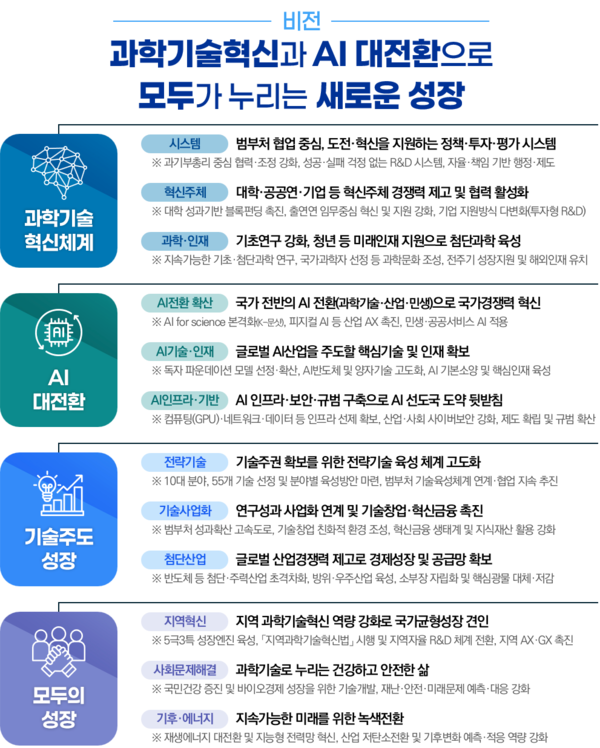
The sixth plan sets a vision of "new growth enjoyed by everyone through science and technology innovation and a major AI transformation" and selected four strategies: the science and technology innovation system, a major AI transformation, technology-led growth, and growth for everyone. Under the four strategies, it comprises 12 key tasks and 40 detailed tasks.
◆ Innovation in the research environment... cut administrative forms by 90 percent and promote challenging R&D
Innovation in the R&D system is the first strategy’s core. It will reorganise an R&D system that had been fragmented by ministry around the deputy prime minister for science and technology, and create a predictable investment environment.
It will cut research administrative forms by more than 90 percent, to 154 from 2,171. To support challenging research that tolerates failure, it will scrap an evaluation grade system and also introduce a method to link follow-up projects to meaningful research regardless of whether targets are met.
It will also strengthen support for talent. It will select 20 "national scientists" each year and provide scholarships annually to 10,000 science and engineering university and graduate students. It will newly support 4,000 postdoctoral researchers by 2030. It will separately allocate 240 master’s-level specialist research personnel in AI each year from 2027 to 2029 to large companies and government-funded research institutes.
◆ Spread AI shift across all fields... build 260,000 GPUs and a sixth supercomputer
The second strategy is a major AI transformation. It will spread an AI shift (AX) across all national sectors including science and technology, industry and the public sector, and continue developing an independent foundation model. It plans to select an independent AI foundation model in 2027 and then advance it into specialised models by sector.
On infrastructure, it will secure 260,000 public-private graphics processing units (GPUs) and build a sixth supercomputer and the National AI Computing Center. It will also pursue technology development for commercialisation of 6G around 2030.
It will also push ahead with institutional revisions. The "Special Act on AI Data Centers" is set to take effect in February 2027, and the "National Research Data Act" in June 2027. It will also pursue an "AI for Everyone" service that anyone can use for free, with a goal of lifting the AI service experience rate to more than 70 percent by 2030 from the current 44.5 percent.
◆ Focus 60 trillion won on 10 strategic technology fields... Semiconductor Special Act to take effect in August
It also adopted a technology-led growth strategy. It will concentrate investment of more than 60 trillion won over five years in 55 technologies across 10 national strategic technology fields: AI, advanced robotics and mobility, next-generation security and networks, semiconductors and displays, advanced bio, next-generation batteries, aerospace and oceans, innovative and future materials, future energy and nuclear power, and quantum.
To promote commercialisation and start-ups, it will expand systems that encourage researcher start-ups, known as Lab-to-Market. It will also expand policy financing such as the National Growth Fund and the Science and Technology Innovation Fund. In semiconductors, support for cluster sites, power and water will be put into full swing as the "Semiconductor Special Act" takes effect in August. The "Special Act on Small Modular Reactors" will take effect in September.
◆ Regional R&D autonomy and healthy life expectancy at 70... balanced growth goals
The fourth strategy is "growth for everyone" encompassing regions, health and energy. Under the "Regional Science and Technology Innovation Act", which takes effect in January 2027, it will expand block-funding-type regional autonomous R&D and intensively foster specialised industries by region in the 5-pole 3-special zones framework.
In climate and energy, it will foster carbon-free energy such as next-generation nuclear power and nuclear fusion alongside a shift to renewable energy such as solar and wind. It will also 추진 early construction by 2030 of an ultra-high-voltage direct current (HVDC) transmission line along the west coast linking Saemangeum and Seohwaseong.
Key performance goals include expanding the number of globally influential researchers to more than 100 from 76, narrowing the strategic technology gap with the top country to within 2 years from 2.8 years, and raising healthy life expectancy to more than 70 years from 65.5 years.
Deputy Prime Minister and Minister of Science and ICT Bae Kyung-hoon (배경훈) said, "The next five years will be a decisive period that will determine the next 30 years of South Korea’s future." He added, "We will strive so that related ministries, the private sector and local governments become one team to make the country strong and not shaken by changes in the external environment and supply chain issues, and so that all people can enjoy the成果 of science and technology."
 Seul-gi Son
sageson@d-today.co.kr
Seul-gi Son
sageson@d-today.co.kr