
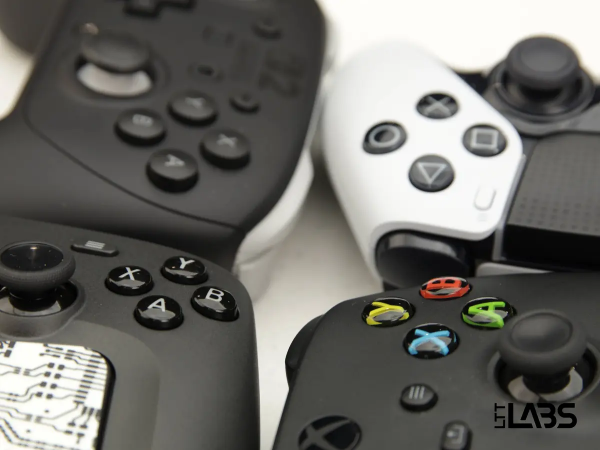
A comparison of button press force across major game controllers found the PlayStation DualSense Edge requires more force than the Nintendo Switch 2 Pro controller. Analysts say the difference in the force needed to press buttons could affect feel and hand fatigue.
Gigazine reported on June 25 that overseas testing organisation LTT Labs measured button press force on the four right-side buttons of the Steam Controller (2026), Nintendo Switch 2 Pro controller, Xbox Wireless Controller and PlayStation DualSense Edge.
The test focused on the A and B, and X and Y buttons often pressed by the right thumb on each controller. A force gauge was used, with results shown in gf. A gf refers to the force exerted by a 1-gram mass under Earth's gravity. The unit is also commonly used to compare keyboard switch actuation force, and typical keyboard switches generally operate at about 30 to 70gf.
The most notable difference was between the DualSense Edge and the Switch 2 Pro controller. The DualSense Edge required 30 to 40gf more force for button input than the Switch 2 Pro controller.
LTT Labs said the difference is not a fatal drawback for most users. It said that in games with frequent repeated inputs or in long play sessions, it could affect feel, fatigue and ergonomic usability. It also raised the possibility that Nintendo lowered button force with hand position in mind, or with smaller and less strong users also in mind.
The difference in button force did not remain only as lab figures. In measurements assuming real gameplay, cases were confirmed in which more than 200gf was easily exceeded with an ordinary press. LTT Labs said users can apply more than 10,000gf overall because they grip the pad with not only the thumb but also other fingers.
For example, it found that even a relatively light action such as holding the boost button in Rocket League applied more than 300gf of force. This shows that not only button actuation force but also actual usage habits and game genre can together affect hand fatigue.
The test also analysed the section in which force increases until a button is fully pressed and the section in which input is released as the hand is lifted. It also confirmed that the point at which input engages and the point at which it releases differ by controller.
There were also some limits to the measurements. Force was not always applied at the exact centre during button presses, and parts of the graph were distorted when the edge of a button was pressed first and the remaining part then dropped quickly. LTT Labs said this can also happen during normal use, but a real finger presses the button with a wider surface area, so it may occur less often than in the experiment.
The results show that even among gamepads, button force design can differ significantly by product. In particular, in action, racing and sports games with fast repeated inputs or frequent long presses, differences in button force can directly affect control feel and hand fatigue.
The industry sees that criteria for choosing a controller may expand beyond simple design, compatibility and battery life to include physical control characteristics such as button force and release feel.
 Jinju Hong
hongjj@d-today.co.kr
Jinju Hong
hongjj@d-today.co.kr