
[DigitalToday reporter Lee Ji-young] Competition among banks to secure young customers is heating up with the launch of Youth Future Savings, a policy product designed to help young people build assets. As most products share a similar structure, including base rates, government contributions and tax exemptions, banks are focusing on preferential-rate conditions, events and affiliate-linked perks to draw young customers into their own financial ecosystems.
According to the financial sector on June 26, banks began accepting applications for Youth Future Savings from June 22. Youth Future Savings is a three-year, flexible installment savings product for young people aged 19 to 34. Customers can deposit up to 500,000 won a month, and those who meet income requirements can receive government contributions and tax exemptions on interest income.
Banks are paying attention to the product because it can secure long-term touchpoints with young customers rather than simply expanding deposits. Youth Future Savings is a policy product that allows only one account per person across all financial institutions. As the bank that signs up a customer may later gain payroll transfers, cards, investments, telecommunications and insurance business, banks are moving aggressively to attract customers early after launch.
KB Kookmin Bank is boosting early demand with a large-scale prize event. It offers prizes worth a total of 1.4 billion won, including 10 million won in cash, home appliance packages, home office packages, hotel vouchers and gold bars, to customers who sign up for Youth Future Savings and register automatic transfers to a KB Kookmin demand deposit account. It also pays savings-support cashback by lottery to customers who do not already hold time deposits or installment savings products, putting emphasis on bringing in new customers.
Shinhan Bank is using investment transaction performance. Its preferential-rate conditions include at least three months of Shinhan Investment Corp trading performance and at least 18 months of Shinhan Card use. It also provides a 1.0 percentage point special preferential rate when customers who hold Shinhan's Youth Leap Account sign up for Youth Future Savings through a linked enrollment. Through events for participation in eligibility screening and for thanking new subscribers, it also offers iPhones and iPads to 3,812 people by lottery.
Hana Bank offers coffee coupons to the first 10,000 final eligible customers. It is also running mobile coupon events for subscribers, including Baedal Minjok and Olive Young, which are popular among young people. It provides two additional deposit and savings rate-preference coupons to customers who switch from the Youth Leap Account to Youth Future Savings.
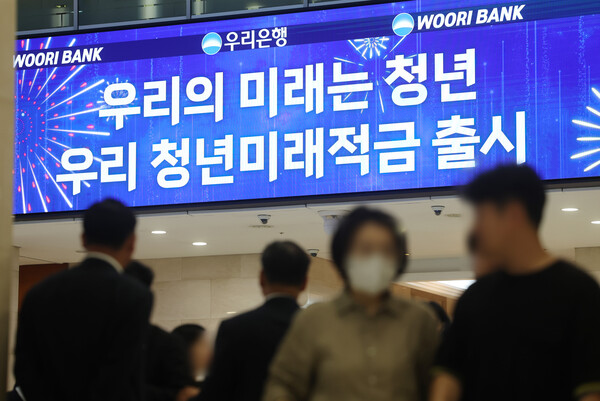
Woori Bank put affiliate-linked benefits across Woori Financial Group at the forefront. It provides Naver Pay points or Samsung Wallet Money points to subscribers. Woori Card, Woori Investment & Securities, Woori Savings Bank, Tongyang Life Insurance and ABL Life Insurance also rolled out card cashback, ETF share distributions, high-interest savings products and youth-only mini insurance products, reinforcing a strategy to keep young customers within the group’s financial businesses. It provides a 0.5 percentage point annual coupon for linked sign-ups with the Youth Leap Account.
NH Nonghyup Bank focused on using MyData and additional deposit subscriptions to broaden the scope of transactions with young customers. Its preferential-rate conditions include payroll transfers, NH Nonghyup Card use and connecting assets through NH MyData. It is also running launch events in separate categories, including new subscribers, customers switching from the Youth Leap Account and customers signing up for a separate deposit, to encourage additional transactions among young people.
Sh Suhyup Bank differentiated itself with fee waivers. It fully waives interbank transfer fees and ATM cash withdrawal fees for subscribers during the subscription period, with no limits on banks or number of transactions. Its maximum rate is 7.0 percent a year, lower than major commercial banks, but it targeted active users through additional fee benefits.
KakaoBank is the only internet-only bank to offer Youth Future Savings. For stable system operations, it will accept applications for up to 200,000 accounts. It will provide, by lottery, coffee exchange vouchers to 1,000 applicants and 30,000 won Baemin gift certificates to 100 applicants.
Banks see Youth Future Savings as another opportunity to secure young customers. With little difference in maximum rates among banks, actual competitiveness is likely to be determined by how difficult it is to meet preferential-rate requirements, links to existing transactions, the convenience of mobile sign-up and additional benefits. The trend is spreading in which policy products targeting young people develop into competition among banks to secure future customers.
In addition, President Lee Jae-myung (이재명) recently instructed that eligible young applicants should not be excluded even if applications exceed the budget, through steps such as compiling an additional budget. With the government’s policy to accommodate as many eligible young people as possible, demand for Youth Future Savings applications is expected to grow.
A banking industry official said, "Young customers are an important customer group in terms of building a long-term transaction base rather than immediate profitability." The official added, "Because a policy product like Youth Future Savings allows only one account per person across the entire financial sector and can be an opportunity to preempt primary banking relationships, banks are moving to attract customers by putting preferential rates, events and affiliate benefits at the forefront."
 Lee Ji-young
ljy@d-today.co.kr
Lee Ji-young
ljy@d-today.co.kr