
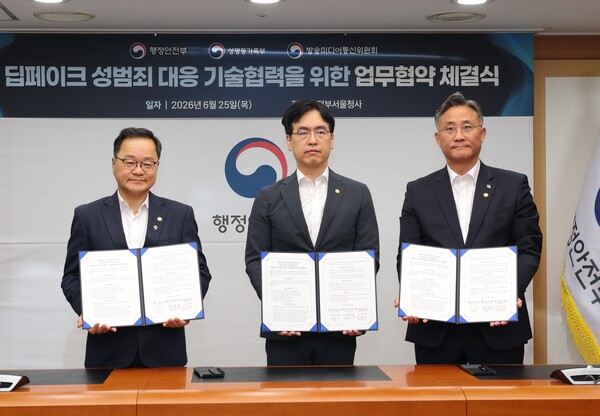
The Broadcast Media Communications Commission, the Ministry of the Interior and Safety and the Ministry of Gender Equality and Family on June 25 signed a memorandum of understanding on AI technology cooperation to respond to deepfake sex crimes at the Government Complex Seoul.
The signing ceremony was attended by Ko Min-soo (고민수), standing commissioner at the Broadcast Media Communications Commission, Kim Min-jae (김민재), vice minister at the Ministry of the Interior and Safety, and Jeong Gu-chang (정구창), vice minister at the Ministry of Gender Equality and Family. Under the agreement, the three agencies will share an "AI deepfake detection and analysis model" developed by the interior ministry with the National Forensic Service, and use it in earnest for detecting, deleting and blocking victim videos and for procedures to protect victims.
Specifically, they will cooperate on sharing and using the AI deepfake detection and analysis model, linking procedures for detecting, deleting and blocking victim videos, and information protection and security measures to prevent secondary harm.
The Broadcast Media Communications Commission will respond to online distribution of content suspected of involving deepfake sex crimes and strengthen the cooperation system for deletions and blocks with platform operators. The interior ministry will continue to upgrade the detection and analysis model in line with developments in AI technology and plans to share it with related agencies. The Ministry of Gender Equality and Family will use both existing private-sector deepfake detection models and the new AI model to analyze and delete victim videos, and will also establish work standards for victim protection and preventing secondary harm.
The plan is that when victim videos or suspected content are received, a first-stage detection and analysis will be carried out using the AI detection and analysis model, and responses will be linked to deletion and blocking and victim support procedures. Each agency will also strengthen security management standards, including restricting unnecessary copying, sharing and storage during the process of handling victim videos.
Interior Minister Yoon Ho-jung (윤호중) said rapid joint responses among related agencies are important because deepfake sex crimes spread quickly and raise serious concerns about secondary harm from resharing and modifications. He said the government will share the AI deepfake detection and analysis model with relevant agencies and build a technology-based cooperation system.
 Seulgi Son
sageson@d-today.co.kr
Seulgi Son
sageson@d-today.co.kr