
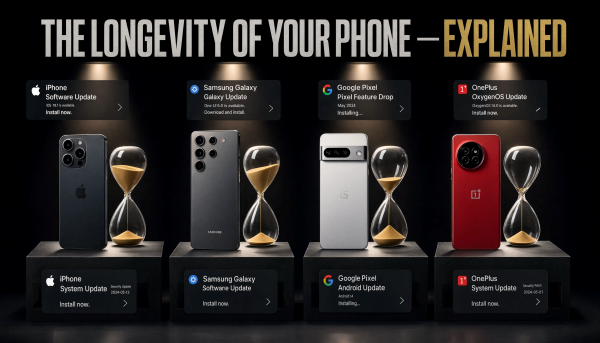
[DigitalToday reporter Jinju Hong] As more consumers use smartphones for longer, the period of support for operating system (OS) and security updates is emerging as a key criterion for purchases. Apple, Samsung Electronics and Google are extending support periods one after another, but differences by brand and model remain large, prompting calls to check before buying.
According to IT outlet TechRadar on June 24 (local time), smartphone makers have recently expanded software support periods, but support policies still vary widely by product line. It has also been suggested that some older smartphones could receive their final updates at the end of 2026.
With smartphone prices rising, consumers are considering not only performance but also how long they can use a device safely as an important purchasing criterion. In particular, the periods of support for OS upgrades and security patches are cited as factors that determine a smartphone’s actual lifespan. TechRadar explained, "Smartphones are a big investment," adding, "It is important to check not only whether it is a good product now but whether it can remain a good product for many years to come."
Support policies also differ slightly by brand. Apple has been providing clearer guidance on minimum support periods since 2024. However, the officially guaranteed minimum of 5 years is based on security updates, and it does not guarantee the same for major iOS updates that add new features. In practice, iPhones often receive updates for about 5 to 7 years depending on the model, but it is difficult to predict an across-the-board final support date, it said.
Samsung Electronics provides up to 7 years of OS and security updates for some of its latest flagship smartphones. By contrast, earlier-generation products or budget models have shorter support, meaning differences can be significant by model even within Samsung smartphones.
Google is also expanding support periods. Devices released after the Pixel 8 series receive up to 7 years of updates, but the Pixel 6 and Pixel 7 series are eligible for 5 years of support. The budget Pixel a series can appear to have a longer support period on paper because it is released later, but the actual number of major OS upgrades may differ depending on the release schedule of major Android versions.
Motorola was assessed as having relatively inconsistent support policies. Some products receive longer-than-expected support, while other models see support end sooner, leaving consumers needing to check policies separately by model.
Chinese manufacturers are also moving to expand support periods. Recently released premium smartphones from Honor, Oppo and Xiaomi are generally expected to receive about 5 to 6 years of update support. By contrast, budget or older products often get only about 2 to 3 years, showing a clear gap by product line.
The industry sees the focus of competition in the smartphone market shifting from hardware performance to long-term software support. However, the guaranteed period differs by maker in whether it includes OS upgrades or refers only to security updates, and policies can vary by model even within the same brand. Experts advised that those planning to use a smartphone for a long time should check the end date for updates alongside the camera and performance.
 Jinju Hong
hongjj@d-today.co.kr
Jinju Hong
hongjj@d-today.co.kr