
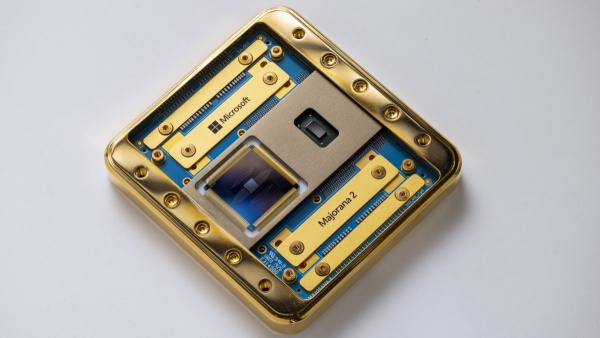
Academics have raised questions over core technology behind Microsoft’s quantum chip, Majorana 2.
On June 24, blockchain outlet Decrypt reported that University of St Andrews physicist Henry Legg (헨리 레그) argued Microsoft has failed to demonstrate the existence of topological qubits.
The dispute targets the technical basis of Majorana 2, a quantum chip Microsoft recently unveiled. Microsoft has said the chip has 1,000 times higher reliability than its predecessor and represents major progress toward realising quantum computing by 2029. It has also said quantum information remained stable for an average of 20 seconds, and some qubits lasted up to 1 minute.
But Legg said in a commentary published in Nature that evidence for topological qubits, which underpins those claims, is insufficient. He said on Bluesky that his criticism exposes flawed tuning procedures, code errors and missing data behind Microsoft’s claim of “breakthrough quantum computing”. He added that Microsoft has not proved even the basic physics needed for a single topological qubit.
At issue are measurement values that Microsoft interpreted as signals of a topological superconducting state. Legg said the signal could reflect experimental flaws rather than the device’s actual characteristics. He said detecting a topological superconducting phase, the basis for topological qubits, is very difficult, and ordinary states can also appear like signals from a topological superconductor.
Legg said unpublished transport data that underpinned Microsoft’s results does not clearly show the superconducting state required for the company’s claims. Instead, he argued the measurements appear to fit other explanations better, such as quantum dot effects.
Microsoft quickly pushed back. Chetan Nayak (체탄 나약), a Microsoft Quantum hardware technical fellow and corporate vice president, said, “We maintain our results and our roadmap.” He said Microsoft has entered the final stage of the U.S. Defense Advanced Research Projects Agency’s quantum benchmarking initiative, and that the process underwent independent verification evaluating public and non-public materials together. He added that skepticism and rigor are features of science and that Microsoft accepts academic scrutiny.
Microsoft later filed an official rebuttal in Nature the same day, arguing its measurements support the conclusion that it created topological qubits. The company said stable signals observed in experiments are consistent with a topological state, and argued such signals would be difficult to produce if, as Legg suggested, they were simple noise or a gapless state.
The dispute also intersects with debate over “Q-day”, the point when quantum computers are said to be able to break public-key cryptography. The cryptocurrency industry is preparing for scenarios in which quantum computers crack widely used encryption methods. Bitcoin has been cited as a particularly vulnerable asset because private keys could potentially be reverse-engineered to steal funds from addresses where public keys are exposed.
The criticism, however, does not deny the long-term threat posed by quantum computers itself. Legg’s concerns focus on how close Microsoft has come to that possibility and whether Majorana 2 is in fact an achievement based on topological qubits. As a result, the quantum computing race is expected to increasingly hinge not only on performance figures, but also on how convincingly key physical phenomena are reproduced and verified.
 Yoonseo Lee
yslee@d-today.co.kr
Yoonseo Lee
yslee@d-today.co.kr