
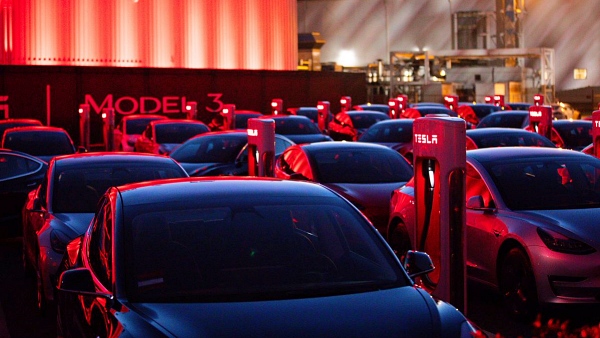
[Digital Today reporter Jinju Hong (홍진주)] Tesla has launched a global event that lets winners use Superchargers for free for as long as they own their vehicles. It is not a simple drawing. Participants compete based on actual charging records and travel performance, and only 9 people worldwide will receive the benefit.
On June 24 local time, electric vehicle outlet InsideEVs reported that Tesla is holding the 2026 Free Supercharging Contest. Tesla said it will provide free lifetime Supercharging to top participants in each region.
Winners will be selected as 3 people each from 3 regions: North and South America, Asia Pacific and Oceania, and Europe, the Middle East and Africa. China is excluded, and some countries also cannot participate.
The contest is a competition based on Supercharger usage performance. Participants will be ranked in 3 categories.
The first is the longest travel record. Participants must visit different Supercharger locations consecutively within 24 hours. They can revisit the same charging station, but to continue the record they must visit a new Supercharger location to restart the 24-hour time limit.
The second is the user who visits the most unique Supercharger locations this year. This category has no 24-hour travel limit, but the number of different Supercharger locations visited determines the ranking.
The third is the user who charges the most electricity at Superchargers. Free Supercharging will also be given to the vehicle owner with the highest cumulative charging amount this year, measured in kWh.
Tesla designed the event so users can naturally achieve various records during everyday driving. The company explained that users can earn achievements by setting a continuous travel record, visiting new charging stations and charging large amounts of electricity, and that it will provide free Supercharging during the vehicle ownership period to top-ranked owners in each category.
Not all users can participate. Vehicle owners already receiving free lifetime Supercharging, users who use vehicles for ride-hailing or delivery purposes, and Tesla employees and their families are excluded.
The competition has already begun. Tesla is including all Supercharger usage records from Jan. 1 this year in its tally, and 174 days of records have already accumulated. Drivers who have frequently taken long-distance trips since the start of the year or used various Superchargers are therefore in an advantageous position.
The size of the Supercharger network is also a variable. The U.S. Department of Energy says 2,997 unique Supercharger locations are currently operating in the United States, accounting for about 20 percent of all U.S. direct current fast-charging stations. In theory, this figure becomes a benchmark for the maximum number of charging stations a participant can visit.
The event shows Tesla's strategy of turning the vehicle ownership experience itself into a game. Tesla has previously used various data to encourage user participation, including safety scores for insurance products and distances driven using driver-assistance functions, and this time it expanded the competitive element to Supercharger usage performance.
Through this, the Supercharger network is expected to go beyond simple charging infrastructure and also serve as a service platform that increases customer engagement.
Only 9 people worldwide will actually receive the benefit. For most users, it is likely to remain a symbolic event, but it is expected to have a meaningful marketing effect by increasing usage among loyal customers and boosting utilization of the Supercharger network.
Future points to watch are how intense the competition becomes by region and whether Tesla will further expand gamified customer engagement programs using its charging services.
 Jinju Hong
hongjj@d-today.co.kr
Jinju Hong
hongjj@d-today.co.kr