
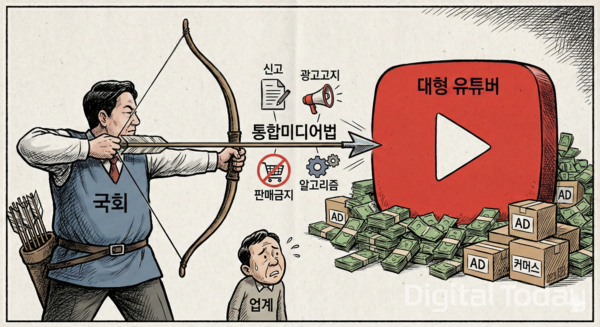
A bill to regulate large YouTubers, titled the Audiovisual Media Services Bill, has been formally tabled at the National Assembly. Its regulatory scope is broader than a draft unveiled earlier this year by a task force under the chair of the National Assembly Science, ICT, Broadcasting and Communications Committee. For some items designated by presidential decree, the provision was changed from banning sales inducement to banning sales themselves. The bill also includes sanctions allowing fines of up to 30 million won for violations.
Choi Min-hee (최민희), a lawmaker from the Democratic Party, on June 18 jointly proposed the bill with 13 lawmakers including Yoon Kun-young (윤건영), Kim Woo-young (김우영) and Han Min-soo (한민수). It would abolish the Broadcasting Act and the Internet Multimedia Broadcasting Business Act, known as the IPTV Act, and enact an integrated law covering new media such as YouTube and OTT.
The bill classifies the provision of content on sharing platforms such as YouTube channels as a "user-produced audiovisual media content service" and includes it among regulated activities.
Reporting criteria set in parallel for subscribers and income; figures set by presidential decree
In January, the integrated media law task force under the committee released a draft without deciding whether the regulatory threshold should be based on subscriber counts or on revenue such as advertising income and donations.
The formally tabled bill, Article 43, specifies both subscriber counts and income as conditions requiring reporting. Creators become subject to reporting if both their income received from a sharing platform and their channel subscriber count exceed certain levels. The specific figures are delegated to a presidential decree. The definition of "large" will be set by a government enforcement decree rather than the National Assembly.
It also adds a new duty for platforms to cooperate. If the Broadcast Media Communications Commission requests relevant data to determine whether a creator is subject to reporting, the sharing platform operator must comply. The provision, not included in the task force draft, provides a legal basis for media authorities to request creators' income and subscriber information directly from YouTube.
From "ban on sales inducement" to "ban on sales"
The task force draft proposed banning explicit advertising and sales inducement for certain products.
The formal bill stipulates that creators must not promote, induce purchases of, or sell goods or services designated by presidential decree. The scope was expanded from banning inducement to banning the act of selling certain goods or services. The prohibited items will be set by presidential decree.
The duty to disclose advertising and sponsorship is also specified. If creators receive in-kind or monetary sponsorship or support, or provide content for the purpose of selling goods or services, they must mark it within the content so it is sufficiently identifiable. The bill also bans promoting specific goods or services or inducing purchases through false or exaggerated means.
Anyone violating the two provisions faces a fine of up to 30 million won. It also stipulates a duty to notify viewers of that fact if a fine is imposed.
Industry says regulatory criteria unclear, warns of self-censorship
The YouTube creator industry pointed to regulatory uncertainty. An official at a multi-channel network said, "If there is no standard for what is allowed and where violations begin, creators will choose not to make ambiguous content at all. That is when self-censorship begins," adding, "As a result, it could bring a chilling effect across the industry."
Experts also said setting the scope of regulation would be key. A media policy expert said, "The reporting duty is structured to be imposed regardless of content genre or nature if certain requirements are met, such as subscriber count and annual income," adding, "Even channels unrelated to public opinion, such as gaming, travel and eating broadcasts, could become subject to regulation, so backlash will be strong." The expert added, "I sympathize with the intent of regulation itself, but it may not be easy to build public consensus."
The bill has been referred to the National Assembly Science, ICT, Broadcasting and Communications Committee and is awaiting review by a bill review subcommittee after the regular September session opens.
 Seul-gi Son
sageson@d-today.co.kr
Seul-gi Son
sageson@d-today.co.kr