
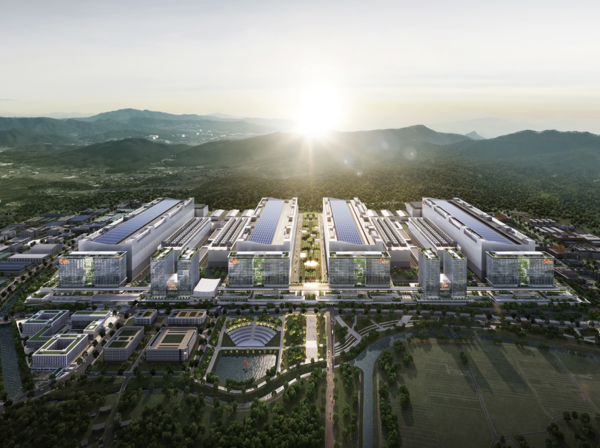
[DigitalToday Dae-geon Seok] As Samsung Electronics and SK Hynix review investments worth hundreds of trillions of won in semiconductor clusters in the Honam and Chungcheong regions, discussion is also expected to accelerate over the government's support approach for the chip industry. A key issue has emerged: whether to underpin fab construction with tax credits or switch to direct cash subsidies like rival countries.
According to the industry on June 25, Samsung Electronics and SK Hynix are coordinating details to announce large-scale investment plans for the Honam and Chungcheong regions at a public-private joint meeting on the "great national land spatial transformation" chaired by President Lee Jae-myung (이재명) later this month. Building both a memory front-end plant and a back-end packaging line is being discussed. Given that the cost of building a single fab phase amounts to at least 60 trillion won, the total investment could reach 300 trillion to 400 trillion won, some observers say.
As the investment size grows, the burden of the support method also increases. Major countries such as the United States, Europe and Japan are competing to attract fabs with cash subsidies that directly deploy tax revenues to secure domestic supply chains. They judge that indirect support such as tax credits alone makes it hard to ease the burden of upfront capital expenditure.
In the United States, a total fund of $52.7 billion has been created through the Chips Act. Of that, 95 percent, or $50 billion, goes into manufacturing facilities and research and development, with cash paid in proportion to investment to companies that build fabs in the country. Samsung Electronics is set to receive $4.745 billion in direct subsidies for its Texas Taylor plant and other projects, while SK Hynix is set to receive $458 million for a back-end line in Indiana. Absolics, a unit of SKC, will also receive $75 million for a glass substrate facility in Georgia.
Europe is also putting in more than 43 billion euros in public and private funding under the goal of raising the bloc's share of production to 20 percent by 2030 after bringing the European Chips Act into force. The German government approved a 5 billion euro subsidy for an open foundry being built in Germany by ESMC, a joint venture between TSMC and NXP. Japan is also known to be putting a large budget into attracting domestic plants and filling a significant portion of construction costs with cash.
By contrast, South Korea is maintaining the K-Chips Act, centered on tax credits rather than direct subsidies, as its core support measure. It reduces a certain percentage of corporate tax payable when companies invest in semiconductor facilities and R&D. The industry says this structure is showing limitations.
Tax credits are retroactive in nature because benefits apply only when operating profit is generated. The industry says the support effect does not work at the initial investment stage, when companies must shoulder massive borrowings and interest for years from groundbreaking to mass production. Industry officials also warn that in downcycles that post losses, there is no tax to pay, effectively stopping the support.
Some also point to differences in cost competitiveness. If part of the investment is reimbursed in cash from the groundbreaking stage, the principal recorded on the books falls and annual depreciation costs reflected each year also decline. By contrast, companies that receive only tax credits must cover investment costs with internal funds and borrowing, putting them at a disadvantage from the starting line in manufacturing cost per chip, the industry view is.
EXPECTATIONS FOR EXPANDED CHIP SUPPORT AS SPECIAL LAW TAKES EFFECT IN AUGUST
The debate over subsidy policy is also intertwined with the government's regional balance development strategy. The government is pushing a national balanced development strategy of "5 hubs and 3 special" and the creation of a southern semiconductor belt. If production facilities concentrated in the Seoul metropolitan area expand into the southern regions such as Honam, competition among regions to attract investment is expected to intensify.
In addition, a semiconductor special law that includes support for semiconductor clusters with regional balance development in mind is set to take effect in August. If designated as a cluster, national funds will support infrastructure such as power, water and roads. Projects will also be exempted from, or given priority in, preliminary feasibility studies applied to fiscal projects with a total cost of 50 billion won or more. Permitting procedures will also be shortened, allowing construction to start earlier, which acts as an incentive for companies to decide on regional investment. It is a point where a shift in the center of support away from the capital region can be sensed.
With rival countries moving to attract fabs with cash, whether support tools will be diversified is cited as a variable. As industry demands for subsidies clash with the government's fiscal burden, the public-private meeting later this month and the special law taking effect in August are expected to be turning points that set the direction for the support method. An industry official said, "Directly paying cash of several trillion won carries a big burden due to tax revenue conditions and controversy over special favors." The official added, "For now, expanding infrastructure or supplementing and expanding tax credits is more realistic."
 Dae-geon Seok
d2dg@d-today.co.kr
Dae-geon Seok
d2dg@d-today.co.kr