
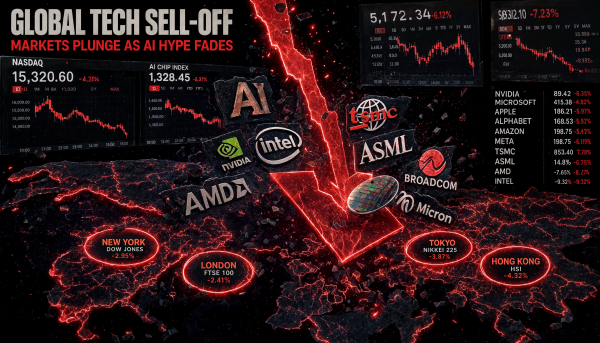
U.S. semiconductor shares fell across the board, unleashing profit-taking across global technology stocks that had led the artificial intelligence boom. Weakness spread from the United States to stock markets in South Korea and Europe, putting semiconductor-sector volatility back at the centre of market moves.
Gigazine, an online media outlet, reported on June 24 local time that the Philadelphia Semiconductor Index fell 7.9 percent from the previous session. Investor sentiment quickly deteriorated as major stocks that had led the AI and semiconductor rally in recent months fell in large numbers.
Losses were concentrated in major chipmakers. Micron and SanDisk each fell 13 percent, while AMD dropped 6 percent and Qualcomm slid 8 percent. Nvidia, seen as a leading AI beneficiary, fell 4.1 percent and its market capitalisation slipped below $5 trillion. The Nasdaq index, heavy in semiconductors, fell 2.2 percent, leaving technology stocks broadly weaker.
The selloff did not stay confined to U.S. markets. In South Korea, Samsung Electronics and SK Hynix each fell about 12 percent, while the KOSPI recorded a drop of nearly 10 percent, its biggest decline in the past 3 months. An automatic trading curb was triggered during the session due to sharp volatility. Markets saw the move as the result of concerns about overheating in the chip sector and concentrated profit-taking by overseas investors.
Europe was not spared. The STOXX Europe 600 technology index fell 3 percent, while STMicroelectronics and chip equipment maker ASMI fell more than 7 percent, the biggest declines among major tech stocks.
Not all tech stocks moved in the same direction. Apple and Seagate fell, but Amazon and Microsoft posted gains. Defensive stocks including Walmart, Procter & Gamble and Johnson & Johnson also rose. That showed investors shifting funds from AI and semiconductor-led growth stocks into relatively stable sectors.
Experts said it was too early to interpret the pullback as a signal of a market collapse. Tom Hyrick (톰 힐릭), chief executive of Strategy Asset Management, said market liquidity remained ample and corporate earnings growth was steady. He said the current situation was closer to a normal correction than a destructive collapse.
The sharp rally to date was also cited as a factor behind the plunge. Micron has risen more than 260 percent this year and surged more than 760 percent over the past year. Over the same period, Samsung Electronics gained more than 400 percent and SK Hynix rose more than 800 percent. Industry watchers said profit-taking concentrated in stocks with large gains, triggering a short-term correction.
Caution ahead of earnings announcements was also seen as a factor. JPMorgan assessed that the selling could have reflected uncertainty ahead of Micron's earnings report. Dan Ives (댄 아이브스), head of technology research at Wedbush Securities, said the pullback was another important test for the AI revolution and forecast that corporate results and AI investment flows would determine the market's direction.
The market's next focus is shifting to semiconductor earnings and whether AI investment continues. In the short term, the chance has increased of a clash between further selling in heavily hit chip stocks and bargain-hunting demand. At the same time, with semiconductor shares in the United States, South Korea and Europe swinging in the same direction, volatility in the key group of stocks that led the AI rally is likely to affect the broader market for some time.
 Jinju Hong
hongjj@d-today.co.kr
Jinju Hong
hongjj@d-today.co.kr