
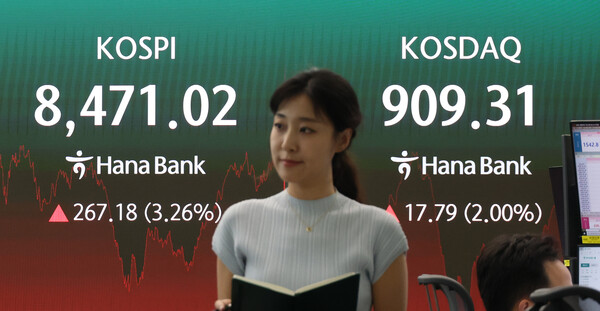
The KOSPI rebounded by more than 3 percent on Tuesday, shaking off the shock of the previous day's plunge. It briefly recovered the 8,500 level during the session, but gave up part of its gains to end around 8,470 as foreign selling and a rising exchange rate weighed.
The KOSPI closed up 267.18 points, or 3.26 percent, at 8,471.02 on June 24. The index opened up 152.95 points, or 1.86 percent, at 8,356.79 and rose to the 8,500 level during the session, but later pared gains and failed to hold 8,500.
In the main stock market, individuals and institutions were net buyers of 2.6085 trillion won and 1.9124 trillion won, respectively. Foreigners were net sellers of 4.6340 trillion won.
Among the top market-cap stocks, Samsung Electronics' rebound stood out. Samsung Electronics ended up 30,500 won, or 9.84 percent, at 340,500 won. It also reclaimed the top market-cap spot in a single day. SK Hynix gained 25,000 won, or 0.98 percent, to 2.58 million won.
Samsung C&T rose 5.82 percent, Samsung Biologics climbed 8.80 percent, Samsung Life Insurance added 1.88 percent and LG Energy Solution gained 0.97 percent.
SK Square fell 1.80 percent, Samsung Electro-Mechanics slipped 1.31 percent and Hyundai Motor declined 0.39 percent.
The KOSDAQ also rebounded. The KOSDAQ ended up 17.79 points, or 2.00 percent, at 909.31. The index, which fell below 900 the previous day, recovered 900 in a single day.
The won-dollar exchange rate rose. The won ended at 1,543.70 per dollar, up 10.20 won, or 0.67 percent, from the previous session.
The KOSPI plunged 9.99 percent and the KOSDAQ fell 7.94 percent the previous day. Sell-side cars were triggered in succession in the KOSPI and KOSDAQ markets, and a first-stage circuit breaker also activated in the main stock market.
In the securities industry, a view has emerged that the previous day's plunge reflected a pullback from the concentration in large semiconductor stocks rather than fundamental damage caused by external negative factors.
Lee Jae-won (이재원), a researcher at Yuanta Securities, said, "The essence of the correction is an expansion of profit-taking appetite following a steep rise and a rite of passage accompanying the process of settling around the 9,000 level." He added, "It is interpreted as profit-taking and a technical pullback in large semiconductor stocks, not a crack in fundamentals."
 Oh Sang-yup
yub@d-today.co.kr
Oh Sang-yup
yub@d-today.co.kr