
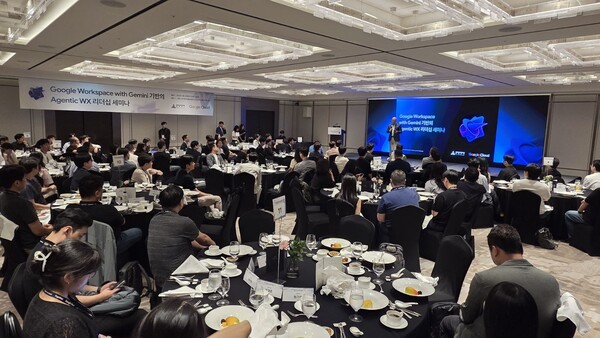
MegazoneSoft, an affiliate of AI and cloud company MegazoneCloud, held an “Agentic WX Leadership Seminar based on Google Workspace with Gemini” in Seoul on June 23 for Google Cloud and C-level executives at major companies, it said.
The event was designed to highlight Google Cloud’s Agentic Workplace Transformation strategy from a management perspective and to introduce Agentic WX proposed by MegazoneSoft for executing AWT.
AWT is Google Cloud’s AI transformation strategy to integrate AI agents into working-level organisational processes and spread them across an enterprise. MegazoneSoft developed the Agentic WX offering on the view that corporate AI transformation must be accompanied by changes in working methods across an organisation.
In AWT, W stands for workplace, while in Agentic WX, W means workforce. That is because in an era of working with AI agents, members’ ways of working and thinking must fundamentally change.
Yeom Dong-hoon (염동훈), CEO of MegazoneCloud, said adopting AI agents is similar to hiring new employees. He said AI agents should be managed in the same way as employees by assigning tasks, evaluating performance and supporting growth. He stressed that the phrase “adopting new technology” is no longer appropriate in the AI era and that people should be able to coexist, grow and learn together with AI.
Choi Jae-eun (최재은), a GCP pre-sales manager at MegazoneSoft, said in a session introducing the Agentic WX offering that it is structured in five stages: assessment, proof of concept, governance, implementation and change management. Choi said the company plans to provide end-to-end support from measuring an organisation’s AI maturity and validating tasks to designing security governance, building systems and managing change for executives and employees.
Ming Kai Lee (밍카이 리), APAC director at Google Cloud, said in a presentation on trends in the evolution of AI-based work environments that for agents to operate as autonomous systems that solve problems on their own, they need context to understand situations, models to reason and tools to execute. He stressed the need for a platform that integrates context scattered across different system boundaries such as email, documents, CRM and ERP and orchestrates agents organically.
The event also shared cases of AI agent adoption at major companies. Kim Jin-sung (김진성), head of a cloud tech unit at MegazoneSoft, introduced cases in which the company supported employees at client firms such as Widaehan Sangsan (Yogiyo) and Hankook & Company to develop AI agents directly.
It also introduced a case of building integrated security governance that meets network separation regulations and electronic financial supervision rules for eight affiliates of a large domestic financial group. Another case applied AI agents to SAP ERP operations at a large IT services company to automate structured and repetitive tasks.
The event also featured a live demo session for experiencing a no-code agent build process based on Gemini Enterprise and setting security governance.
Jin Geon (진건), head of Google Cloud business at MegazoneSoft, said success or failure in AI transformation depends more on strategy, governance and change management than on the technology itself. He said MegazoneSoft will connect enterprise AI agent transformation to tangible results through Agentic WX, which supports the entire process from assessment to change management.
 Chi-gyu Hwang
delight@d-today.co.kr
Chi-gyu Hwang
delight@d-today.co.kr