
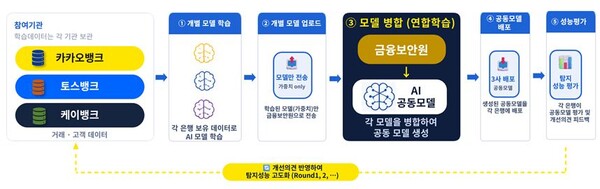
The Financial Security Institute and three internet-only banks - KakaoBank, Toss Bank and K Bank - will apply in the field a federated-learning-based joint AI model to detect voice phishing.
The institute said on Tuesday it has developed the "voice phishing detection joint AI model" using federated-learning techniques with the three banks.
Federated learning is a method that does not share original training data externally, and instead shares and merges only the weights of AI models trained by each institution.
The joint model was designed by combining the on-the-ground experience of the three internet banks, which have developed and operated voice phishing detection AI models, with the institute's federated-learning algorithms.
Using the joint model allows fraud-detection capabilities held by each bank to spread to other banks, enabling it to capture fraudulent transactions that existing standalone models failed to detect. The institute explained that it confirmed the joint model's detection precision improved by up to 205 percent compared with individual models.
The joint model will be deployed from July at the three banks. Each bank plans to use the joint model alongside its own AI model and abnormal transaction detection systems.
The institute plans to gradually expand use of the joint model across the financial sector.
In the fourth quarter, it will install the joint model on ASAP, the institute's AI platform for sharing and analysing telecommunications financial fraud information. It plans to support small and mid-sized financial firms, including second-tier financial institutions, so they can check the possibility of voice phishing for specific transactions.
Park Sang-won (박상원), head of the Financial Security Institute, said it is important for the entire financial sector to build a cooperative system based on mutual growth to respond to voice phishing fraud crimes that are becoming more intelligent and organised.
He added that the institute will also actively conduct AI-based analysis of voice-phishing-related data on the ASAP platform and discover and provide insights and scenarios needed for proactive and preventive detection to lead efforts to protect financial consumers.
 Ji-young Lee
ljy@d-today.co.kr
Ji-young Lee
ljy@d-today.co.kr