
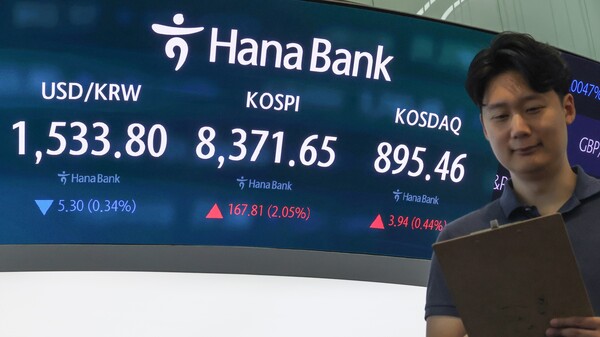
South Korea's KOSPI rebounded a day after a sharp drop and recovered the 8,500 level. Investor sentiment had shrunk enough for sidecars and circuit breakers to be triggered one after another a day earlier, but bargain buying in large semiconductor stocks was seen flowing in early in the session.
As of 9:16 a.m. on June 24, the KOSPI was up 317.92 points, or 3.88 percent, from the previous session at 8,521.76. The index opened up 152.95 points, or 1.86 percent, at 8,356.79 and climbed to the 8,500 level during the session as it recovered losses.
In the main board market, individuals were net buyers of 716.6 billion won. Foreigners and institutions were net sellers of 615.8 billion won and 137.4 billion won, respectively. The won was at 1,534.10 per dollar, up 0.60 won, or 0.04 percent.
The KOSDAQ was also rebounding. At the same time, the KOSDAQ was up 5.26 points, or 0.59 percent, at 896.78.
Among the top market-cap stocks, the rebound in semiconductor shares stood out. Samsung Electronics was trading at 335,500 won, up 25,500 won, or 8.23 percent, from the previous session. SK Hynix was up 135,000 won, or 5.28 percent, at 2.69 million won. Samsung Electronics reclaimed the No. 1 spot by market capitalisation.
Samsung Electro-Mechanics, up 4.22 percent, Samsung Life, up 3.41 percent, and Samsung C&T, up 10.55 percent, were also higher. LG Energy Solution was down 0.83 percent.
A day earlier, the KOSPI closed at 8,203.84, down 910.71 points, or 9.99 percent, from the previous session. The KOSDAQ also ended at 891.52, down 76.88 points, or 7.94 percent. Selling sidecars were triggered in both markets, and a Level 1 circuit breaker was activated on the main board.
Brokerages interpret the previous day's plunge as the result of the burden of concentration in semiconductors and technical correction pressure, rather than damage to earnings. Kyung-min Lee (이경민), a researcher at Daishin Securities, analysed the main cause of the plunge as profit-taking in large semiconductor stocks. He said recent concentration in large domestic semiconductor shares intensified, and supply emerged during the process of easing overheating.
Lee said, "Unlike previous cases, the circuit breaker occurred in the absence of clear external bad news such as U.S.-Iran war risks, international oil prices and a sharp rise in U.S. Treasury yields." He added, "Ahead of the pre-earnings season for the second quarter, fundamental momentum is expected to strengthen as upgrades to earnings forecasts resume," he said.
Ji-young Han (한지영), a researcher at Kiwoom Securities, also said, "It is difficult to see this plunge as being caused by an external shock that directly hits KOSPI earnings and valuations." He added, "It is reasonable to view it as a demand-and-supply side effect created by the spillover effect of leverage in single-stock options and derivatives markets, driven by a rapid intensification of concentration in semiconductors."
 Sang-yeop Oh
yub@d-today.co.kr
Sang-yeop Oh
yub@d-today.co.kr