
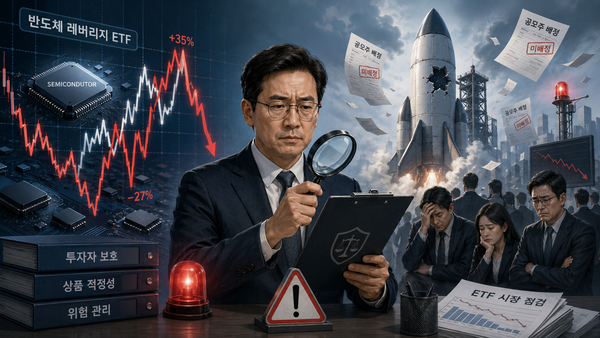
Tension is building in South Korea's financial investment industry, which has been thriving on the rapid growth of exchange-traded funds (ETFs). Investor-protection checks by financial authorities are widening as multiple issues surface at once, including concentration in high-risk ETF investing, promotion tied to inclusion of overseas initial public offerings, compliance with index methodology and management of liquidity providers (LPs).
The Financial Supervisory Service is reviewing investor-protection procedures at asset managers and brokerages, focusing on single-stock leveraged ETFs and SpaceX-related ETFs, the financial investment industry said on Tuesday.
Korea Investment Management, which promoted an ETF by highlighting inclusion of SpaceX IPO shares, has been put on the list for an on-site inspection. Samsung Asset Management, which included SpaceX in a passive ETF on the listing day, will also be checked for compliance with index-calculation methodology.
Lee Chan-jin (이찬진), head of the Financial Supervisory Service, expressed strong concern on June 22 at a media briefing about overheating in single-stock leveraged ETFs. "The extreme turnover in these products is resulting in only brokerages being filled up," Lee said. "I personally worry greatly that the players have no real benefit and only the management and operating system profits."
He said turnover for the products at times came close to 200 percent. He estimated trading fees brokerages could earn from that could be as high as 10 trillion won.
"We issued a consumer alert, but there is no cooling down," he added. "We will discuss with policy authorities what to do step by step, from unsettled trades to margin trading."
Single-stock leveraged ETFs were introduced with the aim of shifting demand for overseas investment to the domestic stock market amid a weak won. Since their launch, net assets have expanded rapidly alongside heavy concentration in semiconductor stocks. The regulator is concerned that retail investors account for a large share despite the products' high risk of losses.
The failure to secure an allocation of SpaceX IPO shares also prompted authorities to broaden the scope of checks. Lee said he did not understand how Mirae Asset Securities received not a single share of SpaceX IPO stock. "The circumstances surrounding the allocation are an absurd situation," he said.
The FSS is inspecting Mirae Asset Securities' investor-protection procedures, the appropriateness of professional-investor registrations and the allocation process by the overseas underwriter. It is also viewing as an investor-protection issue that money from investors who could have bought the stock on the first day of listing if they had not joined the IPO subscription was tied up during the subscription process.
Checks of asset managers are also set to get under way in earnest. Korea Investment Management highlighted that it could include SpaceX at the IPO price through its 'ACE US Space Tech Active' product, but ultimately failed to hold IPO shares.
Some investors filed complaints with police, saying they mistakenly believed the IPO share allocation was confirmed, and police were reported to have launched a preliminary probe on suspicion of fraud. Whether the allegations are established should await the outcomes of the investigation and inspection.
Samsung Asset Management is also subject to checks. The FSS plans to verify whether Samsung complied with index-calculation methodology in relation to including SpaceX on the listing day in its passive ETF, 'KODEX US Aerospace'. Samsung has been reported as saying it had 마련ed a special provision for ad hoc inclusion in the index methodology from the time the ETF was designed.
Korea Investment Management has also recently been caught up in repeated volatility controversies during ETF management, beyond the SpaceX row. On June 8, 'ACE SK Hynix Single Stock Leveraged' closed at 30,000 won, up 49.70 percent, even though its underlying asset SK Hynix fell 7.68 percent.
Its indicative net asset value (iNAV) was 16,164 won, but the closing price was nearly double that level and the premium reached 85.59 percent.
The sharp rise at the time was found to have occurred as a gap in LP quotes just before the close coincided with large buy orders. During the closing call auction starting at 3:20 p.m., LPs are exempt from the obligation to submit quotes.
After a volatility interruption (VI) extended the close execution time by 2 minutes to 3:32 p.m., some LPs were reported to have withdrawn quotes in line with the original closing time, widening the price gap.
A price-distortion controversy also emerged during rebalancing of a nuclear power ETF. On June 12, nuclear-related shares such as BHI, KEPCO Engineering & Construction and Woori Technology surged as high as the daily limit in closing single-price trading. The background was found to be closing-price buying pressure stemming from rebalancing of Korea Investment Management's 'ACE Nuclear TOP10' ETF.
With thin order books, a wave of large buy orders briefly pushed share prices sharply higher, and a substantial pullback appeared in after-hours trading.
The ETF market has grown rapidly on expanded net assets and an influx of investors, but recent controversies are raising questions about whether management systems were sufficient after products were launched.
If financial authorities expand checks to product advertising, index methodology, LP operations and management of leveraged investing, the asset-management industry's race to launch theme-based ETFs is likely to face an unavoidable slowdown.
An official at a financial investment firm said, "As ETF competition intensifies, firms appear to be putting more effort into launching products expected to see high demand." The official added, "With revisions to the stewardship code ahead and asset managers' obligations for responsible investment expected to be strengthened, they need to pay closer attention to internal controls."
 Oh Sang-yup
yub@d-today.co.kr
Oh Sang-yup
yub@d-today.co.kr