
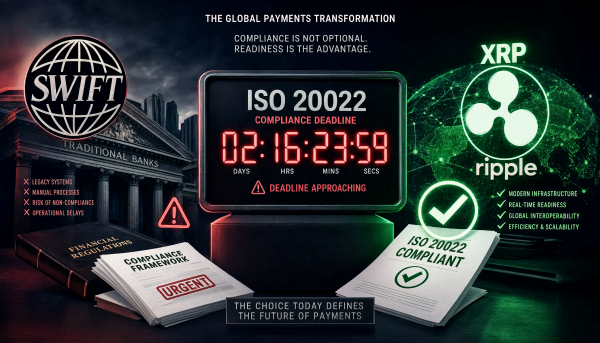
Swift, the international financial messaging network, warned it will no longer allow the use of unstructured postal addresses in cross-border payment messages from November 2026. Payments that do not meet the standard may be delayed or rejected, making it unavoidable for the financial sector to overhaul its data systems.
On June 20 local time, blockchain media outlet U.Today reported that Swift recently said on social media that a key deadline for the ISO 20022 transition is approaching. It said it will not support free-form unstructured address input after November 2026. Swift warned that non-compliant payment messages face a risk of being rejected or delayed.
The measure applies to CBPR+ (Cross-Border Payments and Reporting Plus), Swift's framework for cross-border payments and reporting. The key is to mandate structured-format input for sender and recipient address information.
Swift said the change is not a unilateral decision by the company but an evolution of standards based on agreement across the international financial industry. It said the change is a community-led evolution of the standard and has been approved through formal maintenance procedures and country-by-country voting.
The goal is to improve the quality and transparency of cross-border payment data. Swift said using structured data can increase automated processing efficiency and enable more accurate compliance processes such as anti-money laundering (AML) and know-your-customer (KYC). Market attention is also turning to the impact on Ripple and the XRP ecosystem.
The industry, however, stresses that ISO 20022 and Ripple's payment services are not the same concept. ISO 20022 is an international messaging standard that defines the format in which financial institutions exchange transaction information. Ripple Payments, by contrast, is a separate payment solution that supports companies' cross-border payments using digital assets such as XRP and Ripple USD (RLUSD).
Ripple has already been actively involved in the ISO 20022 framework. Ripple joined the ISO 20022 Registration Management Group in 2020. It joined the organisation as the first distributed ledger technology (DLT) company at the time and signalled its intention to strengthen connectivity with traditional financial infrastructure.
Ripple Payments is currently said to meet ISO 20022, the information security management international standard ISO 27001, and the SOC 2 Type II security audit standard. As a result, the industry believes Swift's data structuring policy and Ripple's regulatory compliance strategy are, in broad terms, aiming in the same direction.
The direct impact of the measure is expected to appear first at traditional financial institutions. Some financial institutions have entered address information in free form, but will now need a structured data format. If they fail to meet the standard, delays or rejections may occur in actual payment processing.
The market believes the change will go beyond a simple technical update and serve as an impetus to accelerate data standardisation across the international payment system.
In the cross-border payment market, renewed attention is also being paid to the need to distinguish between messaging standards and payment infrastructure. If Swift is a messaging network, Ripple is closer to a payment processing solution. Still, because Ripple already has an ISO 20022-based framework and various security and audit standards, it is expected to further emphasise compatibility with the regulated financial market.
 Jinju Hong
hongjj@d-today.co.kr
Jinju Hong
hongjj@d-today.co.kr