
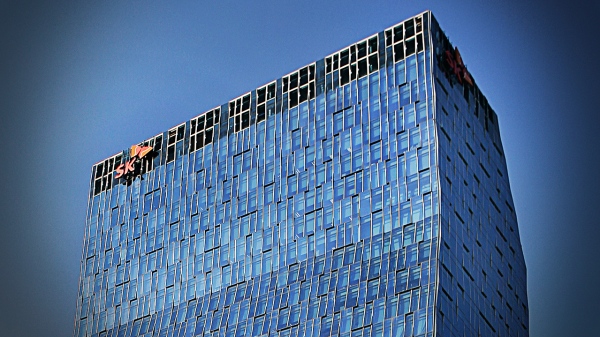
SK Telecom posted a sharp rise in second-quarter operating profit, helped by base effects from costs related to SIM replacement reflected last year and growth in its AI infrastructure business. AI data centre (DC) revenue rose more than 90% from a year earlier, extending its growth. The company plans to secure AI DC customers early and increase investment to make a full leap into an AI company.
SKT said on Tuesday its second-quarter consolidated revenue was 4.36 trillion won and operating profit was 566.0 billion won. Revenue rose 0.5% from a year earlier and operating profit increased 67.3%.
Net profit for the period was 466.0 billion won, up 459.8%. Equity-method gains and losses swung to a profit of 46.9 billion won in the second quarter from a loss of 5.4 billion won a year earlier, affecting the rise in net profit. Earnings before interest, taxes, depreciation and amortisation (EBITDA) rose 17% to 1.44 trillion won. EBITDA margin was 33.1%.
Standalone revenue was 3.12 trillion won, down 0.6% from a year earlier, but operating profit rose 70.5% to 427.7 billion won. SK Broadband revenue was 1.16 trillion won and operating profit was 132.5 billion won, up 3.6% and 44.3%, respectively.
AI DC revenue rises 92.5%; SK Hyper targets new markets
The AI business posted double-digit growth, showing a steep growth trend. AI DC revenue came to 136.2 billion won, helped by expanded operations and contributions from subsea cable revenue. That was up 92.5% from a year earlier and up 3.6% from the previous quarter.
SKT previously opened SJC2 (Southeast Asia-Japan Cable 2), a 10,500-km subsea cable linking Japan, South Korea, Hong Kong and Singapore.
AI B2B and B2C revenue, including AI cloud, AI customer centres, AI factories, generative AI and A.Dot, was 61.3 billion won, up 24.5% from a year earlier. It also grew 36.2% from the previous quarter due to expanded cloud orders.
SKT last month set up SK Hyper, a wholly owned unit. SK Hyper is responsible for developing new businesses such as securing data centre sites and power supply capacity in advance, operating substations, building transmission and distribution lines, and attracting global customers.
SKT plans to invest 750.0 billion won in SK Hyper. Based on that, it aims to gradually expand AI DC capacity to 5 gigawatts from 2029, and then further expand to 15 gigawatts, considering customer demand. The initial investment to be executed this year will be about 330.0 billion won.
Jae-shin Lee (이재신), head of SKT's AI DC business, said on a conference call on Tuesday that rising demand for AI infrastructure was not temporary but a structural change driven by expanding inference demand and wider use of AI across the public sector and industry. He said he expects AI infrastructure demand to continue to expand over the medium to long term.
On the investment plan for SK Hyper, he said SKT would not shoulder all project costs, but would directly lead projects and attract as much outside investment as possible. He said the scale of direct investment would be kept at a limited level.
SKT will push its AI DC business by first securing customers and then pursuing expansion. It also plans to raise the funds needed for construction through financial investors after securing customers.
Wired telecom growth; quarterly dividend 830 won
Mobile subscribers fell 0.1% from a year earlier to 21.97 million in the second quarter. Mobile service revenue fell 1.9% to 2.56 trillion won. Marketing costs rose 3.1% to 747.7 billion won.
In the wired business, growth was led by an increase in high-speed internet subscribers. Wired telecom revenue rose 3.8% to 296.8 billion won. High-speed internet subscribers rose 2.4% to 7.348 million.
Paid TV revenue, however, fell 0.8% to 471.1 billion won. IPTV subscribers rose 0.5% from a year earlier to 6.754 million, but cable TV subscribers fell 3.4% to 2.677 million. Enterprise revenue, including dedicated lines and corporate solutions, fell 3.6% to 280.1 billion won.
SKT's second-quarter dividend is 830 won per share. Total dividends are 176.8 billion won and the dividend record date is July 31. The company will use at least 50% of adjusted consolidated net profit each year for shareholder returns from 2024 to 2026.
The company said base effects from last year's SIM replacement costs and profitability-focused management led to improved results.
Jong-seok Park (박종석), SKT chief financial officer, said the company strengthened its fundamentals in the first half based on its telecom business and laid the groundwork for the AI data centre business to expand quickly. He said SKT will play a leading role as South Korea seeks to become Asia's AI infrastructure hub.
 Jin-ho Lee
jhlee26@d-today.co.kr
Jin-ho Lee
jhlee26@d-today.co.kr