
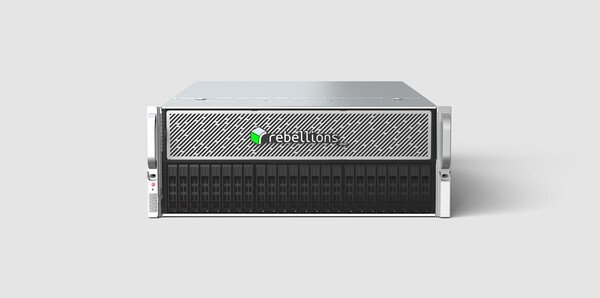
A South Korean neural processing unit (NPU) will be deployed for the first time at a public safety infrastructure site. AI chip company Rebellions said on Sunday it won the server infrastructure contracts for two CCTV control centres, at the Gyeongsangnam-do Provincial Government and Ulsan Metropolitan City, under a project to switch public AI CCTV systems based on homegrown NPUs led by the Ministry of Science and ICT and the National Information Society Agency (NIA). The company plans to supply its server-type NPU, ATOM-Max, to the institutions from August.
The AI CCTV control system in the project is designed in two stages. Cameras or edge devices first detect objects, and servers then analyse footage in detail to determine situations such as fires and crimes. The structure automatically generates a confidence score and a Korean-language description of the situation. Rebellions' ATOM-Max will handle the stage-two server infrastructure.
The ATOM-Max server will run video-language models (VLMs) of 30 billion parameters or more at the control centres to process CCTV footage in detail. VLMs of that size require large memory capacity and high computing performance. It is difficult for small edge chips alone to reliably implement detailed analysis and minimise false positives and false negatives in environments that require large-scale concurrent computing, making server-type NPUs unavoidable, the company said.
Rebellions' server-type NPU can handle large-scale concurrent processing when sudden incidents surge, and can operate independently on closed networks separated from the external internet. It also officially supports vLLM, a standard AI runtime tool widely used by developers. Public institutions can adopt it immediately without changing their existing development environments, which can reduce system reconfiguration costs and the burden of dependence on specific technologies, the company said.
Rebellions recently succeeded in running SK Telecom's large-scale AI model A.X K1, with more than 500 billion parameters, on a single server using its AI server, Rabel Server. It optimised dedicated software to fit the mixture-of-experts (MoE) architecture and distributed computation to NPUs for parallel processing. The company said this secured performance comparable to global high-performance GPU servers with a single homegrown NPU server.
Rebellions CEO Sung-hyun Park (박성현) said, "It is symbolic and meaningful that Rebellions has been involved from the early stages in the government's push to expand the use of homegrown NPUs in the public sector." He added, "Following the recent proof of a homegrown NPU's performance through demonstrations of a homegrown large-scale AI model, this time we will use that technological capability to create a turning point where sovereign AI moves beyond demonstrations and establishes itself as on-site infrastructure that protects public safety."
 Daegeon Seok
d2dg@d-today.co.kr
Daegeon Seok
d2dg@d-today.co.kr