
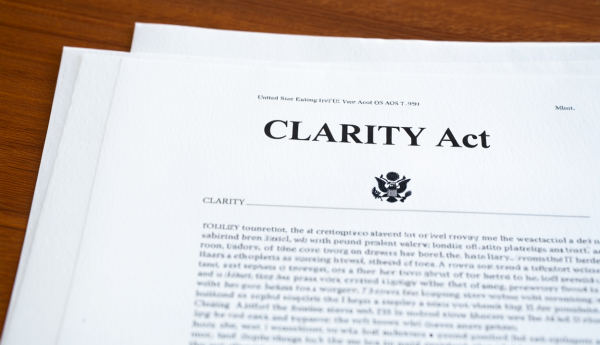
[Digital Today reporter Yoonseo Lee] The U.S. Clarity bill has been placed on the list of measures eligible for a Senate floor vote, but the key variable for passage has narrowed to securing about seven Democratic votes.
On June 19 (local time), blockchain outlet The Defiant reported that the House is ready to move quickly on related legislation if the Senate takes up the bill.
The bill is listed as No. 423 on the Senate legislative calendar, meaning it can be put to a floor vote whenever leaders set the schedule. Dusty Johnson, chairman of the House Agriculture Committee's digital assets subcommittee, said the House would respond quickly if the Senate passes the bill before the August recess. If the House moves to approve the Senate-passed version as is, it can shorten the House-Senate reconciliation process that can typically take several weeks.
The hurdle in the Senate is high. The bill must secure 60 votes in a cloture vote to overcome a filibuster. Republicans hold about 53 seats, leaving a shortfall of about seven votes even if all Republicans support it. The only Democrats with a public record of support are two senators, Ruben Gallego and Angela Alsobrooks, who voted for it in the Senate Banking Committee. Both senators have also made clear that their committee vote does not mean final support.
Even within the Senate, there is a sense that a goal of passage before July 4 will not be easy. Eleanor Terrett, host of Fox Business' "Crypto in America," said on June 14, "Legislating the Clarity bill by July 4 is realistically impossible." She pointed to an ethics-clause standoff, House-Senate text alignment and the 60-vote math all coming into play at the same time. Senator Cynthia Lummis also said a vote before the August recess is more realistic than one before July 4.
The bill's core is to divide digital assets into three legal categories. Ethereum that meets certain standards, including bitcoin, would be classified as a digital commodity, putting even spot and cash markets under the jurisdiction of the Commodity Futures Trading Commission (CFTC). Investment contract-type assets sold to fund a central organization would fall to the Securities and Exchange Commission (SEC). Payment stablecoins would be overseen by banking regulators under the framework of the Genius bill.
What the industry has long demanded is to place non-security tokens under a CFTC-centered framework. The bill also includes language to specify XRP as a digital commodity under federal law. The House passed its own bill in 2025 by 294 to 134, and more than 70 Democrats voted in favor at the time.
Democratic negotiating conditions are also relatively clear. Senator Kirsten Gillibrand said Democrats would not allow passage without an ethics provision aimed at the issue of public officials benefiting from holding cryptocurrencies. The issues have narrowed to conflict-of-interest prevention language, stablecoin interest rules, illicit finance and anti-money laundering (AML) clauses, and decentralized finance (DeFi) protection provisions. During committee review, an ethics amendment by Chris Van Hollen was rejected in a 13-11 party-line vote. Senate strategists are now seeking a narrower ethics text that can add seven Democratic votes while minimizing Republican defections.
Political money is also in the background of the negotiations. Fairshake-affiliated political action committees (PACs) reported holding $193 million as of early this year. Coinbase and Ripple each put in $25 million, and a16z contributed $24 million. Protect Progress, a Democratic-aligned group, also spent $1.5 million in one House Democratic primary in March to run an opposing campaign. Political pressure is affecting both lawmakers who are friendly to crypto policy and those who are not.
The House has publicly signaled its intent to shorten procedures. Johnson said that if the Senate passes a combined text, the House can move related legislation immediately rather than insisting on a separate conference committee. House Financial Services Committee Chairman French Hill has also indicated the same direction. In that case, a Senate-passed bill could go to the president after a single House vote. The Senate text, however, must be sufficiently close to the House version for French Hill and Tom Emmer to whip votes.
The remaining schedule has two paths. If the Senate adjusts the ethics clause and the stablecoin interest clause and clears the floor with more than 60 votes, signing could be possible by mid-to-late July. If floor amendments break the existing coalition, it could move to a House-Senate recalibration and slip until after the August recess.
The market is also aware of the possibility of delays. The head of Galaxy Research on June 8 lowered the estimated probability of passage within 2026 to 60 percent. Prediction markets are reflecting a probability of around 70 percent. In the end, even if Senate leaders set a floor schedule, the bill's fate still depends on ethics language that has yet to be finalized and on securing additional Democratic votes.
 Yoonseo Lee
yslee@d-today.co.kr
Yoonseo Lee
yslee@d-today.co.kr