
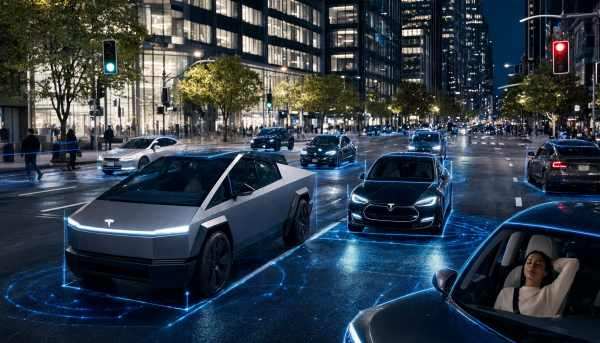
A Wall Street assessment said Tesla's Full Self-Driving (FSD) software has effectively reached Level 4 self-driving in most conditions.
On June 11, electric vehicle outlet CleanTechnica reported that Piper Sandler analyst Alexander Potter (알렉산더 포터) argued Tesla FSD has "effectively reached Level 4 autonomy, at least in most conditions."
The assessment came as Tesla still runs FSD as a "supervised" system. Potter cited recent business moves rather than the technology's performance itself. He first pointed to Tesla applying lower insurance premiums to customers who use FSD heavily. "You don't lower the price of a product you think will cause insurance claims," he said.
Preparations for a robotaxi business were also cited. Potter said he believes Tesla began mass production of the "Cybercab" from April and estimated the investment could range from several hundred million dollars to $1 billion, or more than 1.52 trillion won. He said such capital spending would be hard to justify without being ready to deploy FSD at scale. Tesla is also reported to be working to secure permits for a facility in Irving, Texas, with 200 parking spaces and 16 Superchargers.
Signals of service expansion were also mentioned. Tesla began disclosing the number of FSD subscribers from the first quarter of 2026 after previously being reluctant to make it public. Potter interpreted this as meaning FSD is "ready to spread beyond early adopters." Tesla also said it would expand its robotaxi service to seven more cities in the first half of 2026. He acknowledged the target "may be unrealistic" but said "the trend is clear."
Potter also cited real-world experience. He said he personally owns a Tesla vehicle equipped with FSD and introduced a case in which he drove only using FSD from Missoula, Montana, to Minneapolis, Minnesota, in April. He said there have been multiple recorded cases in which long-distance driving was completed without human intervention in good weather conditions.
There is also substantial pushback. A leading criticism is that performance is not sufficient in severe weather and that the sensor setup is lacking to handle rain, snow and strong sunlight. Critics also say reliability remains weak in complex urban driving. While mistakes have declined compared with the past, there are also concerns that as users become more familiar with the system, they may respond later to situations requiring intervention.
Robotaxi operating metrics are also a point of debate. Some said collision data for Tesla robotaxis operating in Austin, Texas, fall short of expectations. Tesla began the service in Austin in late 2025, but the number of vehicles in operation is still not large, according to reports. Elon Musk said in July 2025 that "by year-end, about half of the U.S. population will be using autonomous ride-hailing services," but the pace of expansion is assessed as falling short of that remark.
The liability structure also remains a task. Tesla does not currently take direct legal responsibility even if an accident occurs while a driver is using FSD. Critics also say Tesla uses statistics from supervised FSD as if they were evidence of readiness for unsupervised autonomous driving. The technology has clearly improved, but separate verification is needed on whether it has led to actual Level 4 commercialisation, some say.
That narrows Tesla's next points to watch to two. The first is whether the promised city expansion actually happens. The second is proving whether performance improvements in supervised FSD can translate into operating an unsupervised robotaxi. How Tesla presents safety data and a liability framework as it expands service areas and operating scale is expected to be key.
 Seung-a Yoo
ysah@d-today.co.kr
Seung-a Yoo
ysah@d-today.co.kr