
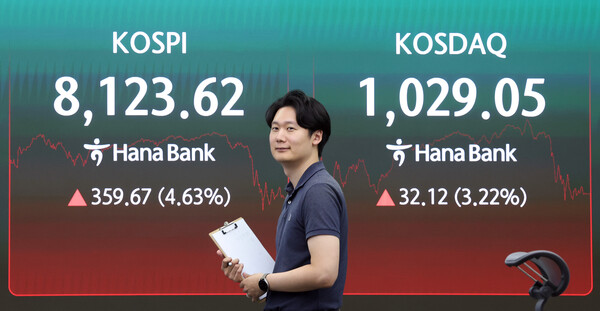
South Korea's KOSPI on Thursday rose more than 4 percent to reclaim the 8,100 level. Gains in U.S. stocks overnight and strength in semiconductor shares fed into the local market. Foreign investors turned net buyers for the first time in 24 sessions since May 7, and institutions also joined buying to lift the index. The Kosdaq also gained in the 3 percent range and held the 1,000 level.
The KOSPI closed up 359.67 points, or 4.63 percent, at 8,123.62. It opened up 499.90 points, or 6.44 percent, at 8,263.85 and rose as high as 8,434.40 during the session.
The KOSPI started strongly, topping 8,300 early in the session. Strength in KOSPI 200 overnight futures and a rebound in U.S. semiconductor shares were reflected, extending the rise from the previous day. The gain narrowed somewhat during the session, but it closed above 8,000.
Foreign investors and institutions led flows. In the main stock market, foreigners posted net buying of 2.1063 trillion won and institutions net bought 2.4013 trillion won. Foreigners, in particular, returned to net buying for the first time in 24 sessions since May 7, supporting the index rebound. Retail investors, by contrast, net sold 4.3367 trillion won.
Most top market-cap stocks rose. Samsung Electronics closed at 322,500 won, up 23,500 won, or 7.86 percent, from the previous close. SK Hynix ended at 2.15 million won, up 49,000 won, or 2.33 percent. Large semiconductor shares rose together, underpinning the index rebound.
Elsewhere, SK Square gained 10.59 percent, Hyundai Motor rose 1.68 percent, LG Energy Solution climbed 4.03 percent, Samsung Life rose 5.62 percent, Samsung C&T gained 5.37 percent and HD Hyundai Heavy Industries added 0.62 percent. Samsung Electro-Mechanics fell 5.04 percent.
The Kosdaq also advanced. It closed up 32.12 points, or 3.22 percent, at 1,029.05. The Kosdaq, which had neared the 1,000 level at 996.93 the previous day, climbed back above 1,000 and extended gains.
In the Seoul foreign exchange market, the won was quoted at 1,522.00 per dollar, down 3.00 won from the previous session. The exchange rate rose slightly, but the burden on stocks was limited as foreign buying flowed in.
Han Ji-young (한지영), a researcher at Kiwoom Securities, said, "It is also a time to consider that the environment for sector rotation is improving as the recent correction in the domestic stock market eases the burden from record-level surges and concentration."
She said, "As the Kosdaq remains in an excessively sidelined state, to the extent that its performance still significantly lags the KOSPI, there is a need to maintain greater interest than before."
 Oh Sang-yeop
yub@d-today.co.kr
Oh Sang-yeop
yub@d-today.co.kr