
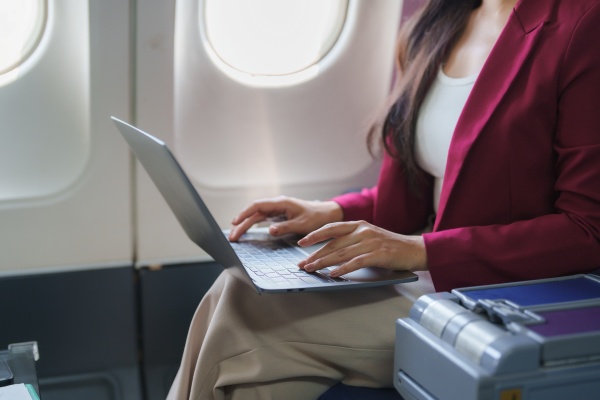
Inflight WiFi satisfaction has jumped sharply over the past year, emerging as a key variable in airlines’ service competition.
CXToday reported on June 11 that inflight WiFi satisfaction scored 79 out of 100 in the American Customer Satisfaction Index (ACSI) 2026 travel survey. That was a sharp rise from 66 a year earlier. It matched inflight food and beverages and exceeded seat comfort, which scored 76.
Inflight internet was once rated lower than baggage handling, seats and inflight meals. Recently, airlines have been adopting next-generation satellite communications, including Starlink, changing perceived quality. Low-earth-orbit satellite connectivity, in particular, shows clear differences from existing systems in speed, stability and latency.
The limits of conventional inflight communications lay more in structure than in investment size. Air-to-ground systems using terrestrial base stations lose connectivity over the sea. Geostationary satellites are about 35,786 km from Earth, pushing round-trip latency to 600 to 800 milliseconds. That made services needing real-time response, such as video conferencing, cloud collaboration and internet calls, effectively difficult. Passengers repeatedly experienced long buffering even after buying inflight internet passes, and they lowered expectations on the premise it would not work at all.
Market research also supports the shift. Moment’s inflight connectivity benchmark shows 80 percent of passengers see inflight WiFi as essential to their trip. Demand to keep working while flying has grown as remote and hybrid work spread. As a result, inflight internet has become a service tied directly to productivity rather than a simple convenience function.
The change is also affecting corporate travel demand. Companies with large travel budgets increasingly view connectivity as an important criterion in preferred-carrier contracts. If employees repeatedly lose work time during flights, that creates an operational reason to move to a competing airline. It means inflight internet is spreading beyond passenger satisfaction into an issue of retaining corporate customers.
Starlink is at the center of the trend. Starlink operates in low earth orbit at an altitude of 340 to 560 km, about 50 times closer to Earth than geostationary satellites. As a result, round-trip latency has fallen to 30 to 80 milliseconds, and per-aircraft speeds are typically presented as 100 to 350 Mbps. Starlinkflights.com compiled passenger reports showing a peak of 424 Mbps and an average of 234 Mbps.
Ookla’s Speedtest Intelligence data for the second half of 2025 also shows the gap. Ookla said, "Starlink’s worst day is on par with a competitor’s best day." It said speeds for the bottom 10 percent of Starlink users were 63.71 Mbps, faster than the median of other satellite networks. Ookla measured consistency as the share exceeding 25 Mbps download and 3 Mbps upload, and some airlines that introduced Starlink met that productivity threshold in more than 95 percent of cases.
Airlines are also putting inflight connectivity at the forefront as a core service. Emirates President Tim Clark announced the adoption of Starlink and said, "We will introduce the fastest WiFi in the world and raise what passengers can expect from inflight connectivity." Chad Gibbs, vice president in charge of Starlink’s business operations, also said passengers on Emirates flights would be able to stream, game and make uninterrupted video calls "as they would on the ground."
Not every major airline has chosen the same path. Delta Air Lines selected Amazon’s Project Kuiper, with deployment set to begin in 2028. JetBlue has taken the same approach and plans installations from early 2027. With the current performance gap widening, the competitive landscape could become clearer between airlines that stabilise low-earth-orbit satellite links first and those that remain on existing systems.
In this situation, the possibility of an initial public offering for SpaceX is also drawing attention. SpaceX remains unlisted, but was valued at more than $200 billion in a recent funding round, and the market is watching the possibility of an IPO within days. If a listing is completed, the pace of expanding satellite networks could accelerate, and competitive pressure on existing operators and around Project Kuiper could also increase.
Inflight WiFi has entered a stage where it is hard to classify it as only an add-on service. With it influencing passenger reviews as well as corporate travel contracts and airline loyalty, the pace of shifting to satellite communications is expected to become the next turning point in airlines’ service competition.
 Jinju Hong
hongjj@d-today.co.kr
Jinju Hong
hongjj@d-today.co.kr