
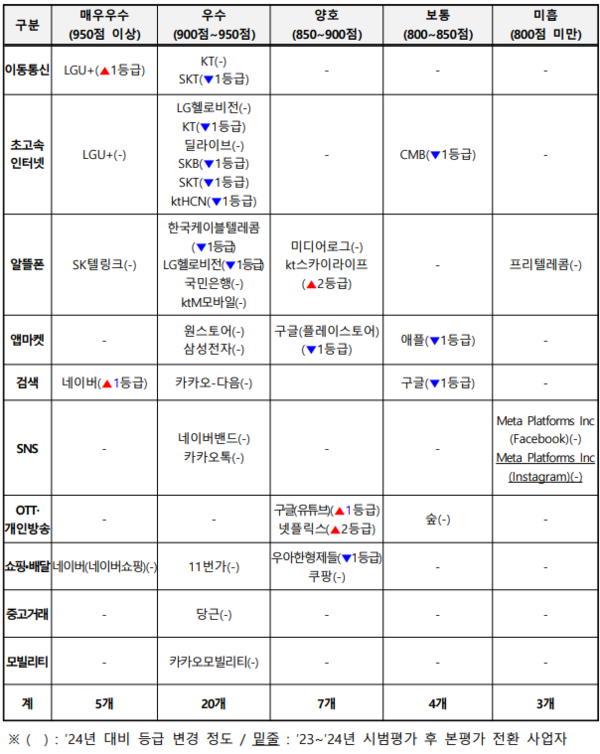
South Korea's Broadcasting Media Communications Commission said on Thursday that an evaluation of user protection work at 47 telecommunications operators last year showed the overall level fell or was flat from a year earlier.
The commission held its 17th plenary meeting of 2026 on Thursday and reviewed and approved the results of the 2025 assessment of user protection work by telecommunications operators. The assessment is conducted annually under the Telecommunications Business Act and the results are disclosed.
The assessment covered 47 companies across 12 service areas, including facilities-based and value-added telecommunications. Newly included were Unicomz (budget mobile), Temu (shopping), Coupang Eats (delivery), Tving and Coupang Play (OTT), and Chzzk (personal broadcasting).
The overall average score for 39 companies, excluding eight subject to a pilot assessment, was 873.3 points, down 13.4 points from a year earlier.
Grades for large facilities-based operators generally fell. In mobile communications, SK Telecom fell by one grade, KT was unchanged and LG Uplus rose by one grade. In ultrafast internet, SK Broadband, SK Telecom and ktHCN each fell by one grade.
Value-added telecommunications operators were at a similar level to a year earlier, but were assessed as lacking efforts to prevent the distribution of illegal information and to provide remedies for damage caused by false or exaggerated product information. An assessment of protection work for business users such as small merchants, creators and riders was newly introduced, but scores for related indicators were generally low.
In social networking services, Instagram was included in the main assessment for the first time but received an insufficient rating along with Facebook. Netflix Korea and KT Skylife actively participated in specialist consulting and rose by two grades to receive a good rating.
Three cases were selected as best practices in user protection: ktHCN's "one-call customer consultation", KT Skylife's policies to prevent identity theft and fraudulent sign-ups, and Naver's expansion of its counterfeit appraisal programme.
The commission said it decided not to grant, or to defer until facts are confirmed, the benefit of reduced penalty surcharges given to operators rated good or higher, considering the issue of security breach incidents involving major telecom companies in 2025.
Kim Jong-cheol (김종철), chair of the Broadcasting Media Communications Commission, said damage to users was becoming more complex and widespread and operators should make every effort to build proactive prevention systems. He added the commission would also do its best to ensure operators' user protection capabilities improve in practical terms through developing more sophisticated evaluation indicators and providing tailored consulting.
 Seulgi Son
sageson@d-today.co.kr
Seulgi Son
sageson@d-today.co.kr