
Stellantis and solid-state battery developer Factorial Energy have begun the first on-road test of a solid-state electric vehicle battery in North America. As verification moves beyond laboratories and test tracks into real road conditions, some say the race to commercialise next-generation batteries is entering a new phase.
Electrek reported on June 11 that Stellantis and Factorial began on-road driving tests in North America using a Dodge Charger Daytona development vehicle fitted with Factorial's solid-state battery cells. The companies said the test is the first case of integrating a solid-state battery into a North American EV platform and validating it in real road conditions.
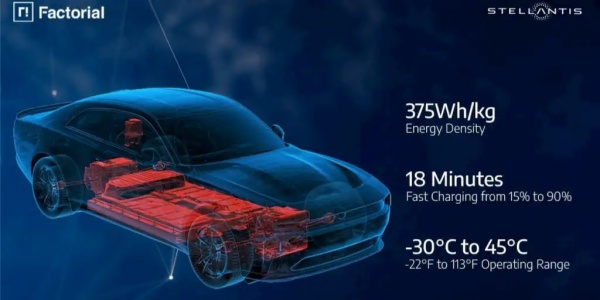
The battery applied in the test is Factorial's FEST (Factorial Electrolyte System Technology) cell. During the verification stage last year, the battery confirmed an energy density of 375 Wh per kg based on 77 Ah and performance of more than 600 charge and discharge cycles.
Charging speed and temperature durability were also presented as strengths. Factorial said the FEST cell can be charged from 15 percent to 90 percent in about 18 minutes. It also maintained stable performance in extreme conditions ranging from minus 30 degrees Celsius to 45 degrees Celsius and supports up to a 4C discharge rate.
The companies said transferring laboratory results to an actual vehicle was not easy. Stellantis said it newly optimised the battery pack structure and control system in integrating the FEST cell into its STLA Large platform. It said the focus was on securing safety and performance at the same time.
Si-you Huang (시유 황), Factorial's chief executive officer, said, "Building everything together from cell chemistry technology to battery pack design made the road test possible." She said, "This kind of full-stack collaboration is essential to commercialise solid-state batteries." She added, "This achievement goes beyond simply validating FEST technology and is a step toward setting a new standard for automotive solid-state batteries."
Factorial is already pushing to commercialise solid-state batteries with several global automakers. Partners include Mercedes-Benz, Hyundai Motor, Kia and Stellantis. Mercedes-Benz drove more than 745 miles in September last year with a modified EQS fitted with Factorial's solid-state battery cells. At the time, Markus Schaefer, Mercedes-Benz's chief technology officer, said the technology could become a "game changer" for the EV market.
Factorial plans to expand the scope of its technology beyond automobiles to robotics, aerospace and defence industries. The company projected its solid-state battery could improve driving range by up to 50 percent compared with existing EVs, providing a driving range of more than 600 miles (about 965 km) on a single charge.
Factorial also recently completed a merger with special purpose acquisition company Cartesian Growth Corp III and listed on Nasdaq under the ticker symbol "FAC". The combined company's enterprise value was estimated at about $1.3 billion, and the company plans to secure about $110 million to speed up commercialisation of solid-state batteries.
Industry watchers say the road test will be an important milestone for gauging the commercialisation potential of solid-state battery technology. If results that have remained at the laboratory level are proven in real vehicle operating conditions, it is expected to have a significant impact on the landscape of the next-generation EV market.
 Jinju Hong
hongjj@d-today.co.kr
Jinju Hong
hongjj@d-today.co.kr