
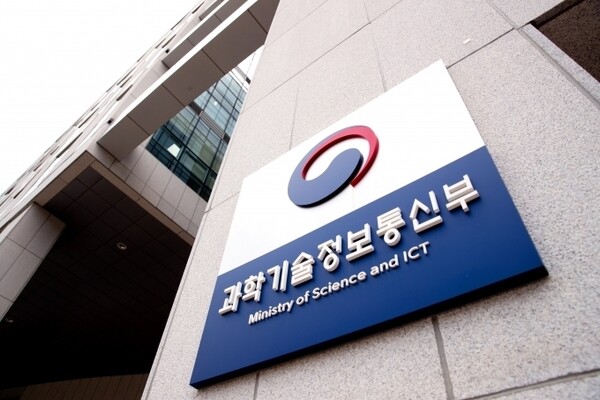
South Korea's Ministry of Science and ICT on Thursday held a kick-off briefing at the Catholic University Seoul St. Mary's Hospital for the "AI-native advanced bio autonomous laboratory construction project" and listened to views from the field.
The project is a key foundational initiative to realise the government's K-Moonshot mission to accelerate new drug development. The ministry will invest a total of 49.5 billion won from 2026 to 2028 to build 1 general-purpose autonomous laboratory and 5 specialised autonomous laboratories.
The goal is to ease bottlenecks in bio research and development through AI and robotics and to promote lab-level AI transformation. The ministry plans to improve bottleneck processes in advanced bio experiments and to implement an AI-native research environment in a "closed-loop" format, in which AI designs experiments, robots carry them out and the results are learned.
Officials from the ministry, the Korea Research Foundation, the K-Moonshot new drug development programme director, principal investigators and research teams attended the briefing, where 6 selected research projects presented their plans. Plans for building autonomous laboratories were shared, divided into general-purpose and specialised areas.
Oh Dae-hyun (오대현), director general for future strategic technology policy at the ministry, said autonomous laboratories combining AI and robotics would be a game changer that changes the paradigm of bio R&D. He said the government would foster AI-native autonomous laboratories as core infrastructure for the K-Moonshot mission to accelerate new drug development and create an innovative ecosystem for bio research.
 Jin-ho Lee
jhlee26@d-today.co.kr
Jin-ho Lee
jhlee26@d-today.co.kr