
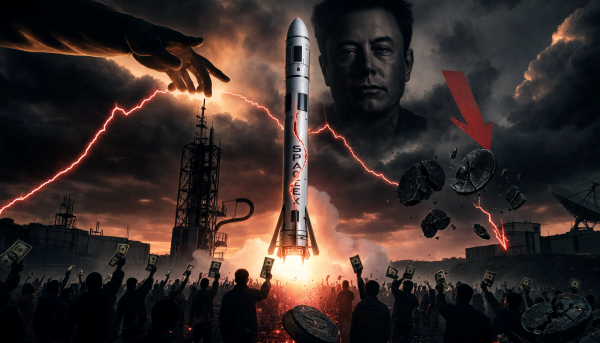
[DigitalToday intern reporter Seung-a Yoo] SpaceX plans to sharply increase the amount allocated to retail investors in its initial public offering (IPO).
On June 10 (local time), Bloomberg reported that SpaceX is pursuing a plan to allocate up to 30 percent of the total offering to retail investors who buy shares through personal accounts.
That is a big expansion compared with the typical 5 to 10 percent retail allocation in IPOs. SpaceX will take retail subscriptions through Charles Schwab, Fidelity, Robinhood, SoFi and Morgan Stanley's E-Trade. At Fidelity, investors with at least $2,000 in their account balance can be allocated IPO shares. That is far lower than the $100,000, and as much as $500,000, thresholds required in other share offerings.
If demand overheats, not all investors who express interest may receive an allocation. SpaceX is being cited as a candidate for the largest IPO ever, and retail money is expected to pour in.
The market also sees post-listing volatility as a key variable. SpaceX warned that the share price could swing sharply given a structure with a high share of retail investor participation. A sharp rise in so-called meme stocks such as GameStop in 2021 is cited as a case in which retail flows significantly moved market prices.
There are also constraints on trading aimed at short-term gains. Some brokerages have policies that limit future IPO allocations to investors who resell IPO shares just days after listing. That means investors could face disadvantages if they immediately take profits even if the stock jumps after listing.
There is also no guarantee that a first-day surge will lead to long-term returns. IPO expert Jay Ritter (제이 리터) of the University of Florida's Warrington College of Business said the average first-day gain for IPO stocks from 1980 to 2025 was about 19 percent. But excluding first-day trading, they posted annual returns 3.6 percent lower over the following five years than similarly sized existing listed companies.
Fundamentals are also a key variable in investment decisions. SpaceX had $29.1 billion in debt as of the end of March. It posted a loss of $4.9 billion last year and a loss of $4.3 billion in the first quarter this year. The company said it may not be able to turn a profit in the future.
Corporate governance is also controversial. The IPO will offer 555.6 million Class A shares with one vote each, and it will not offer Class B shares with 10 votes each. Elon Musk (일론 머스크) holds a large amount of Class B shares and can control more than 82 percent of total voting rights even after the listing. SpaceX acknowledged that conflicts of interest could arise between Musk and other companies he owns, such as Tesla.
The governance controversy persists. SpaceX will offer 555.6 million Class A shares with one vote each. Class B shares with 10 votes each are not part of the offering. Musk can control more than 82 percent of total voting rights even after the listing. SpaceX acknowledged that conflicts of interest could arise between Musk and other companies he owns, such as Tesla.
Investors also need to watch for ticker confusion. SpaceX is set to trade under the ticker 'SPCX', which is only one letter different from Virgin Galactic Holdings' ticker 'SPCE' owned by Richard Branson (리처드 브랜슨). In the early period when orders flood in after listing, investors could confuse the company name and ticker, and they should check carefully.
 Seung-a Yoo
ysah@d-today.co.kr
Seung-a Yoo
ysah@d-today.co.kr