
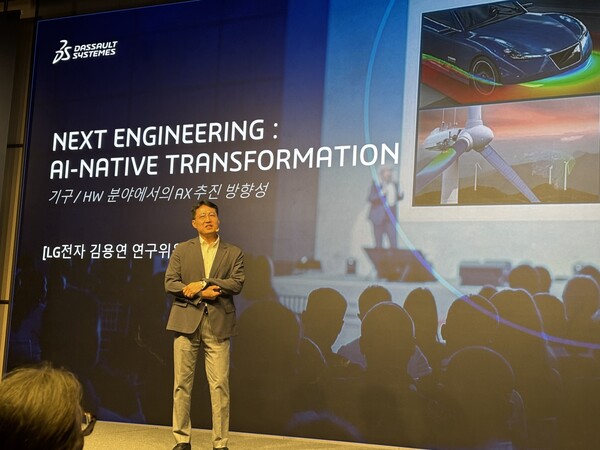
"It is a bias already shattered that large language models (LLMs) cannot do mechanical engineering."
Kim Yong-yeon (김용연), a research fellow at LG Electronics' VS division, said in a keynote speech at the Simulia User Data 2026 conference hosted by Dassault Systemes Korea on Wednesday that the perception that LLMs cannot properly handle mechanical engineering is now collapsing. Cases of manufacturers adopting agent AI have risen quickly, he said. Trust in AI answers has also risen sharply, he stressed.
LLMs have mainly been used in software development or front-line work settings, and there has been a widespread perception that they carry less weight in hardware development. Kim said dramatic changes have taken place over the past year.
LLMs are being recognized as capable of being used at an expert level in engineering, he said. Global auto-parts company Continental built an ontology-based knowledge graph using a multimodal vision-language model, after moving beyond a method of parsing and embedding text and images, he added. He said output model reliability then rose to a level that could not be compared with before.
Kim said that as recently as 4 years ago, the industry's focus was digital transformation (DX) to improve efficiency by processing and visualizing data. Now, most companies have put AI transformation using LLMs forward as a core task. For hardware engineers, he said, AX has a relatively lower barrier to entry than DX. Citing LG Electronics, he said the arrival of AI has made it possible to produce visible results in hypothesis validation and process improvement that were difficult during the DX era.
Citing LG Electronics, he also made clear that the key in AX is not adopting technology but improving the quality of engineers' decision-making. AX should be seen not as simply introducing AI but as redesigning workflows, he said.
Kim said LG Electronics conducted a comprehensive survey of how much time engineers at its research center actually spend on research and development work. The results revealed an "uncomfortable truth". Engineers were spending more time on various response tasks, so-called "busywork", than on the work they should be doing as engineers.
Data discontinuity was also a practical problem. Data was scattered across personal workstations, laptops and internal servers. Silos between the research center and the quality, purchasing and production divisions were also factors blocking collaboration.
LG Electronics analyzed work across the entire process from product planning to mass production. The number of connected tasks involved in developing a single product exceeded 440, he said. LG Electronics reviewed the possibility of applying AI to each task and redesigned its development process by defining best practices for each stage. "The key is not that AI replaces work, but that it changes the structure so engineers can focus on core judgments by removing repetitive work," Kim said again.
Kim said competition among companies in the global manufacturing market is intensifying, making the strategic value of AX, which preserves the essence of improving decision quality, inevitably grow. He pointed in particular to China's rise in the global auto market.
"The average product development period in the global auto industry is about 30 months or more, but China makes them within 18 months," he said. "It does not stop at making them cheaper and faster, and quality is also catching up." He said an article came out a year ago saying China was starting to appear in the side mirror, but now China is already ahead. "It is uncomfortable but true," he said. "This kind of pressure instead became an opportunity to take AI seriously," he said.
 Hwang Chi-gyu
delight@d-today.co.kr
Hwang Chi-gyu
delight@d-today.co.kr