
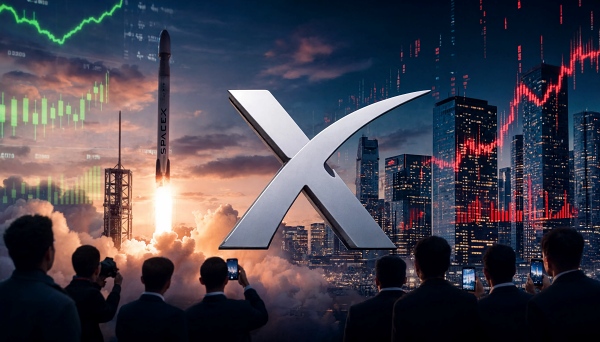
Elon Musk (일론 머스크)'s SpaceX is pursuing an initial public offering of about $75 billion, drawing renewed attention to the biggest IPOs in history.
Hong Kong's South China Morning Post (SCMP) reported on Tuesday that energy, e-commerce, telecoms, autos and finance companies rank among the world’s largest IPOs so far. The listings are seen as reflecting national industrial strategies and market conditions, beyond simple fundraising.
The biggest IPO in history is Saudi state oil company Aramco. Aramco listed on Saudi Arabia’s Tadawul stock exchange in December 2019 and raised $29.4 billion. It was one of the core projects of Saudi Crown Prince Mohammed bin Salman (무함마드 빈 살만)'s Vision 2030 programme. Only about 1.5 percent of shares were actually offered to the market, and demand was driven more by investors in Saudi Arabia and the Middle East than by global institutional investors. Even so, the Aramco IPO remains the world’s largest by funds raised.
Second is Chinese e-commerce company Alibaba. Alibaba listed on the New York Stock Exchange in September 2014 and raised $25.0 billion. The stock jumped more than 38 percent on its first day of trading, and its market value reached about $231.0 billion. At the time, mainland Chinese media rated Alibaba as the world’s second-largest internet company after Google.
Third is Japan's SoftBank. SoftBank listed in Tokyo in December 2018 and raised $23.6 billion. SoftBank Group, led by Chairman Masayoshi Son (손정의), sought to secure investment capacity through the telecoms unit listing and grow the company into a global technology investment firm.
The stock fell more than 14 percent on its first day of trading. Investor sentiment was hit by a nationwide telecoms outage and concerns about intensifying competition with Rakuten Mobile. It was a case showing that a large IPO does not always translate into a hit.
Fourth is General Motors. GM listed simultaneously in New York and Toronto in December 2010 and raised $23.1 billion. It returned to the market 17 months after completing bankruptcy protection procedures during the global financial crisis.
GM was delisted from the New York Stock Exchange in 2009 amid falling sales, an economic downturn and a sharp rise in fuel prices. The U.S. government later injected close to $50 billion to restructure the company. The GM IPO remains a case symbolising a troubled company’s recovery and a return to private markets after government support.
Fifth is the Agricultural Bank of China. The lender listed simultaneously in Shanghai and Hong Kong in July 2010 and raised $22.1 billion. Volatility was high in mainland Chinese and Hong Kong markets due to fallout from Europe’s debt crisis, but the large listing was completed as planned. The deal completed the stock market debuts of China’s four major state-owned commercial banks. The Agricultural Bank of China IPO is seen as showing the marketisation of China’s financial system and the trend of reforming state-owned banks.
SpaceX's planned IPO has been cited as potentially surpassing these records. If it succeeds in raising $75 billion, it would far exceed the existing record set by Aramco.
The ranking shows that large IPOs are not merely corporate fundraising events. Aramco and the Agricultural Bank of China had a strong national-strategy character, while Alibaba, SoftBank and GM reflected market trends such as internet industry growth, a shift to technology investment and post-crisis recovery, respectively.
SpaceX is also assessed as a company combining expectations for space development, satellite internet and artificial intelligence infrastructure. If a listing materialises, it is expected to set a new record for the largest IPO and serve as a test of investor demand for space and AI infrastructure companies in global capital markets.
 Yoonseo Lee
yslee@d-today.co.kr
Yoonseo Lee
yslee@d-today.co.kr