
As power demand from AI data centres surges, founders who previously worked at SpaceX have entered a new power supply business combining solar power and batteries. They plan to target the next-generation power market by touting lower costs and faster deployment than natural gas generation.
On June 10, TechCrunch reported that U.S. energy startup Ambrosia Energy is developing a power supply system that combines solar generation and lithium-ion batteries, and is targeting AI data centres as its main customers.
The company’s core strategy is not to develop new generation technology but to combine existing solar and battery technologies to supply stable power 24 hours a day. Ambrosia Energy aims to cut the cost of power production to about $100 per megawatt hour. That is lower than the roughly $107 per MWh that investment bank Lazard estimates for new combined-cycle gas plants.
The company also cited plant construction speed as a competitive edge. Sarah Spangelo (사라 스팽글로), co-founder and president, said plants could be built within 12 months from signing a contract to supplying power. She said the advantage is speed, with gas turbine plants currently facing equipment lead times of 5 to 7 years.
The key to cutting costs lies in how the battery is operated. Typical grid batteries charge and discharge quickly in 2 to 4-hour cycles, but Ambrosia Energy adopted a structure that charges slowly during the day and discharges slowly at night. The company said this reduced stress on the battery and lowered overall system costs.
The founding team comes from the space industry. Spangelo and CEO Ben Longmier (벤 롱미어) previously worked together at satellite communications startup Swarm, and after SpaceX acquired it they also took part in the Starlink business. Spangelo is a former Google employee, and Longmier has worked at Apple and several space startups.
The company started without outside investment and recently raised funding from venture capital firm DFJ Growth. The size of the investment was not disclosed.
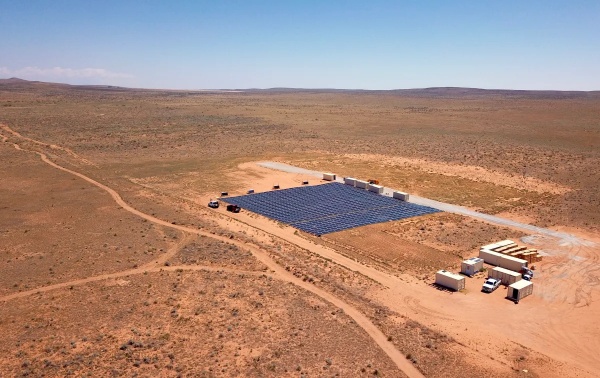
Ambrosia Energy has already entered the demonstration stage. The company began building its first plant in West Texas in January and said construction progress has reached about half. Some equipment has already started operating and is running normally, it was reported.
Scalability was also presented as a key strength. The company is starting with projects of tens of megawatts but aims in the long term to build gigawatt-class plants. Spangelo said the system can be expanded to near-infinite levels, and said the company plans to provide an environment where customers can verify performance before signing large contracts.
CEO Longmier said some partners have secured access rights to about 1 million acres of land. That is enough, by research standards, to build a solar complex of about 30 gigawatts.
The company plans to reduce its reliance on off-the-shelf components and expand the use of in-house designed equipment. It is also pushing ahead with building a manufacturing plant in Austin, Texas. The goal is to carry out larger projects faster and secure gigawatt-class power supply capability before 2030.
The industry is watching whether Ambrosia Energy’s approach can become a new alternative as AI data centre power demand explodes. With natural gas power plant construction being delayed, attention is focused on whether a large-scale power supply model using solar and batteries can prove both economic viability and stability.
 Jinju Hong
hongjj@d-today.co.kr
Jinju Hong
hongjj@d-today.co.kr