
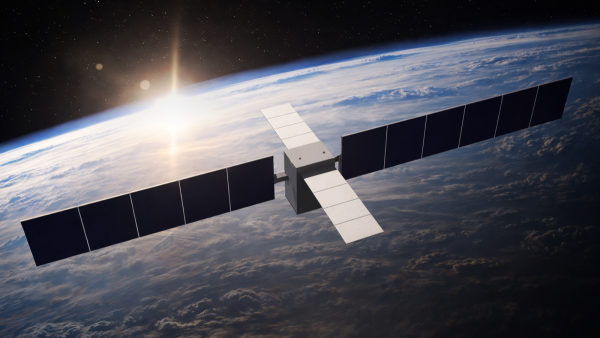
Orbital, a startup that aims to build artificial intelligence (AI) data centres in space, has raised $5 million in seed funding. It plans to build infrastructure to run AI inference computing in orbit, free from power and site constraints on Earth.
TechCrunch reported on Monday that Orbital has recently emerged officially after going through Silicon Valley venture capital firm Andreessen Horowitz’s (a16z) startup accelerator programme, Speedrun.
Orbital was founded by Euwyn Poon (유윈 푼), a co-founder of electric scooter sharing service Spin. He founded Spin in 2017 and sold the company to Ford the following year. After leaving Ford, Poon focused on the rapid growth of the AI infrastructure market and ultimately chose the idea of a space data centre.
Orbital’s core plan is to shift soaring AI computing demand from Earth to space. The company is focusing on the fact that space can reliably secure solar energy and that environmental regulation and permitting burdens from building data centres on the ground are relatively smaller.
Constraints are also significant. The biggest obstacle now is launch costs. In an interview, Poon said the business would only become fully feasible once SpaceX’s next-generation heavy-lift Starship launch vehicle is commercialised. “Once Starship starts operating, we can scale to full size,” he said. “With the current Falcon 9 launch cost structure, the economics do not work.” Orbital plans to focus on technology validation for now rather than building large-scale infrastructure.
A team of about 12 based in Los Angeles includes people who previously worked at Amazon’s low-Earth-orbit satellite business, SpaceX and Northrop Grumman. The company is preparing a demo flight that will mount Nvidia Blackwell chips on a partner’s satellite to test radiation shielding and thermal management technologies.
Orbital is targeting 2028 for the launch of its first data-processing spacecraft. The spacecraft is expected to carry Nvidia’s next-generation space AI chip, using a GPU on the level of its “Space-1 Vera Rubin”.
The company plans to add satellites one by one, carry out AI inference work and build a revenue model in stages. The strategy is seen as similar to that of rival Starcloud, which is already trying to operate GPUs in orbit.
Orbital’s long-term vision is much larger. The company has set a goal of ultimately deploying 10,000 satellites to build a distributed AI computing network with a total capacity of 1 gigawatt (GW). It aims to secure about 100 kilowatts of power per satellite to handle large-scale AI workloads.
Competition in the space data centre market is also ramping up. Besides Orbital, Cowboy Space Company is developing its own launch vehicle, and Jeff Bezos’ Blue Origin has also disclosed plans to build a space data centre using the New Glenn rocket.
Orbital expects various operators to be able to coexist in the future. “Depending on the types of AI tasks, data centre design methods and operating models, the market can be divided into several areas,” Poon said. Referring to his experience running an open-weight AI model service using Nvidia A100 GPUs after leaving Ford, he stressed that “in the AI era, computing power itself is an important asset.”
Investors are also showing a more favourable attitude toward long-term projects than in the past. a16z partner Andrew Chen highly valued Poon’s experience building an electric scooter network of 250,000 vehicles across more than 100 cities.
“This kind of business may require more than 10 years to complete and billions of dollars in capital, but today’s venture ecosystem is ready to accept a much longer time horizon than before,” he said.
The industry sees Orbital’s success as ultimately depending on Starship’s commercialisation and results from early technology demonstrations.
The idea of running AI computing in space is no longer just one company’s concept, but limited-scale experiments and validation are expected to come first until launch costs are sharply reduced.
 Jinju Hong
hongjj@d-today.co.kr
Jinju Hong
hongjj@d-today.co.kr