
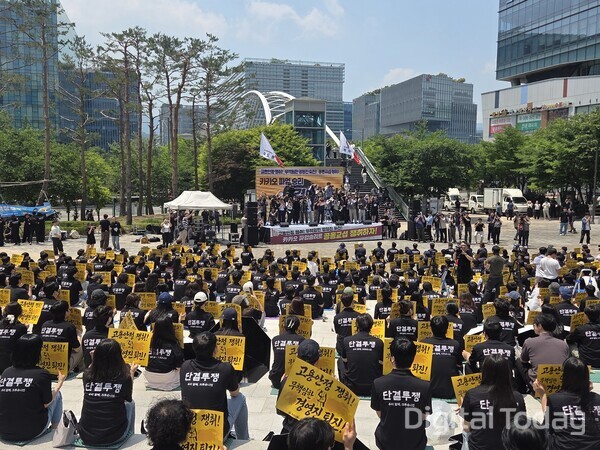
Kakao's labour union held the first partial strike at the company's headquarters since its founding and staged a large rally around Pangyo, demanding job security and accountability from management. The union also warned of an additional walkout on June 29 dubbed a "logoff day". Labour-management conflict over whether performance pay includes restricted stock units (RSUs) appears to be spreading into disputes over compensation system changes and job insecurity.
The Kakao branch of the Korean Federation of Chemical, Textile and Food Industry Trade Unions, which the union calls the union, began a rally at 11:30 a.m. on June 10 at Pangyo Station Square in Seongnam, Gyeonggi Province, and marched to Y-Space Square. Police estimated 500 participants, while the union estimated 800.
Five entities took part in the partial strike, including Kakao headquarters as well as KakaoPay, Kakao Enterprise, DK Techin and XL Games. It was the first strike at Kakao at the headquarters level since the company was founded. The union said about 1,000 people joined at Kakao headquarters and about 1,500 across all entities.
At the rally, union members formed lines wearing black T-shirts reading "Solidarity struggle" and holding white parasols. Placards across the crowd read "Win job security·Remove irresponsible management". A marching line led by a traditional percussion group stretched from Pangyo Station Square to Y-Space Square. The march went ahead as planned despite hot weather above 25 degrees Celsius. Members chanted "Win job security" and "Remove irresponsible management" as they passed in turn in front of IT company buildings around Pangyo, including Nexon, XL Games, NC and Neowiz. Near the offices of Pangyo IT companies including NC, Webzen and XL Games, they also stopped briefly and raised shouts urging job security and responsible management.
A coffee truck set up by the union also appeared at Pangyo Station Square. A banner on the truck read, "Management that monopolises performance amid job insecurity must step down," and members of the Kakao union and the IT committee under the federation lined up to receive drinks. Folk songs played in the square along with the sound of performances by a traditional music troupe.
Unions under the IT committee of the federation, including those at Naver, Nexon, NC, Netmarble, Hancom and Yanolja, joined in solidarity in addition to Kakao members. Kakao's internal labour-management conflict overlapped with labour issues in the Pangyo IT industry, giving the rally the character of a solidarity gathering as well.
Speakers at the site raised direct questions about management's compensation structure. Park Sung-ui (박성의), senior deputy branch chair of the Kakao branch, said, "Management failure is management's judgment, so why must workers bear restructuring and layoffs resulting from it in full?" He added, "Executive pay at KakaoPay rose 30 percent, but I want to ask why employee pay rose only 3 percent."
The rally follows a breakdown in wage and performance pay talks. The union is calling for performance pay funding worth 13 to 15 percent of Kakao's standalone operating profit last year, and says RSUs worth 5 million won should be calculated separately from performance pay. The company, by contrast, proposed a performance compensation plan that includes RSUs, and the union said the total compensation amount in that case would be around 10 percent of operating profit.
Key services including KakaoTalk and KakaoPay operated normally during the rally and partial strike. The industry view is that the likelihood of service disruptions that users would notice from a short strike is limited because server monitoring, failure detection and traffic distribution for large platform services are largely automated and essential operating staff are being maintained. A Kakao official said, "We are operating a real-time response system to ensure stable service operation and minimise customer impact," and added, "We will continue to talk with and consult the union to reach an agreement as soon as possible."
Key variables ahead are whether talks resume and whether a June 29 logoff strike becomes reality. Seo Seung-wook (서승욱), head of the Kakao union branch, said at the rally, "The company is deteriorating due to mistakes and wrongdoing by management," adding, "We chose a joint struggle because of a structure in which management does not take responsibility for management failure. Kakao's real renewal must be made not by management but by crew." Seo also warned of an additional walkout on June 29, but said the specific form, including whether it would be a full-day strike or a general strike, is still under discussion.
With labour and management still far apart over the size of performance pay funding, whether to include RSUs and demands for job security, it is unclear whether an agreement can be reached in the short term. With union members from headquarters and affiliates moving together and unions from the Pangyo IT industry joining in solidarity, the outcome of future talks is expected to be a factor determining whether the June 29 logoff strike is carried out.
 Lee Ho-jung
lhj@d-today.co.kr
Lee Ho-jung
lhj@d-today.co.kr