
[DigitalToday reporter Chi-gyu Hwang] "There are more IT monitoring tools, but the problems remain."
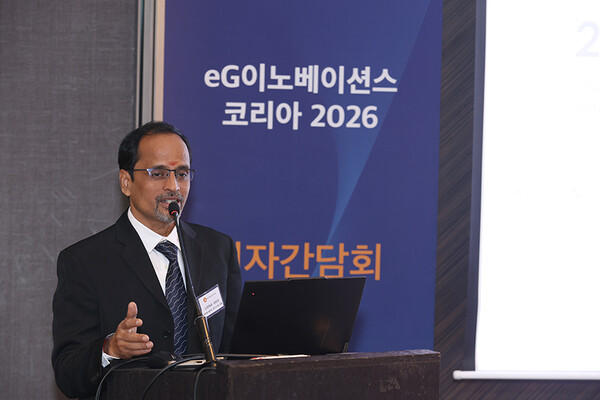
Observability company eG Innovations' head of global solutions engineering, Srihari Avar (스리하리 아바르), said corporate IT operations teams are facing a growing burden as IT environments become more complex with hybrid structures spanning on-premise and cloud. He made clear the need to take a single-platform approach.
At a media briefing eG Innovations held at The Plaza Hotel on Tuesday morning, he said many companies use multiple monitoring tools but complexity persists. He summarised the problems companies face in IT operations into 3 main areas.
The first is alarm overload. "IT teams are buried under countless alarms, most of which are unrelated to real user issues," he said. "As a result, the truly important signals get buried, and when something breaks it takes hours just to identify the cause," he said.
The second is the proliferation of tools. Citing global survey results, he said 74% of corporate IT teams run 2 to 5 monitoring tools at the same time, and 17% use more than 5. "Because each tool only provides fragmented information, it is difficult to grasp the full context. Network tools do not know application status, and storage tools do not know network conditions," he said. The third is wasted manpower. He pointed to survey results showing 68% of help desk staff do not know which backend team to route a customer inquiry to. He added that 41% of IT experts spend 75% of their working time only on identifying the cause of incidents.
At the briefing, eG Innovations said the solution is to monitor the entire stack with a single platform, from user experience to network, applications, systems, cloud, databases and storage.
eG Innovations provides EG Enterprise as a single monitoring platform. The company said automated dependency analysis and a correlation engine can automatically identify root causes without manual connections between tools.
Domain intelligence is another keyword the company emphasises. Avar said EG Enterprise can natively monitor more than 650 technologies. He said it has agents specialised for each domain such as SAP, Citrix, VMware and AWS, rather than agents that collect only general metrics.
Avar particularly highlighted capabilities for SAP and virtual desktop infrastructure (VDI) environments.
He said more companies are moving SAP ERP to the cloud, but SAP's own tools alone make it difficult to assess infrastructure status and performance. He said VDI environments use different tools depending on the platform, including Citrix, VMware Horizon and Microsoft AVD, making it difficult to secure cross-platform visibility. He said EG Enterprise provides single-platform visibility in both environments.
eG Innovations is also accelerating efforts to strengthen its AI capabilities. It currently supports automated root-cause analysis, self-learning-based dynamic threshold settings, and integration with ChatGPT and Gemini. It also plans to soon add integration with Microsoft Copilot and Anthropic Claude, monitoring of large language model (LLM) performance, and a retrieval-augmented generation (RAG)-based knowledge bot. Over the mid to long term, it aims to use AI for autonomous incident management, self-healing infrastructure and an operating environment without human intervention.
On AI functions, Avar said, "All vendors claim they have built in AI, but the real question is what AI it is, what problems it can solve, and how much operational knowledge it contains." He said anomaly detection alone is not enough, and companies must be able to find the root cause and explain the impact on the business.
Avar also emphasised South Korea as an East Asia strategic hub. "We are expanding the execution model we validated in South Korea to Taiwan and Japan," he said.
After Avar, Kim Hyun-chan (김현찬), head of eG Innovations Korea, shared plans to target the domestic market.
He said the company has continued annual average growth of more than 30% since setting up its South Korea office in 2018, and is expanding its business centred on SAP PCE (Premium Cloud Edition) and VDI monitoring. He said the company plans to focus on the domestic SAP PCE (Private Cloud Edition) visibility market and the integrated monitoring market for VDI infrastructure. He said it aims for 50% market share in SAP PCE specialised operations and automation, and 30% market share in integrated monitoring for VDI infrastructure.
 Chi-gyu Hwang
delight@d-today.co.kr
Chi-gyu Hwang
delight@d-today.co.kr