
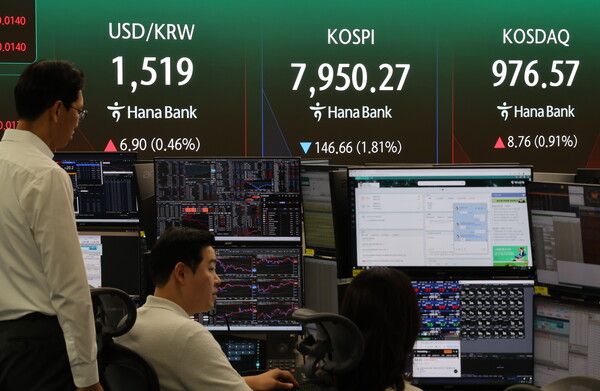
South Korea's KOSPI fell more than 4 percent intraday on Tuesday, triggering a sell sidecar on the main bourse. The market's direction swung sharply just a day after a buy sidecar was triggered on a sharp rebound the previous session.
The Korea Exchange said that at 1:16:25 p.m., swings in the KOSPI200 futures index halted the effectiveness of program sell orders on the main board for 5 minutes.
At the time it was triggered, the KOSPI200 futures index was down 64.65 points, or 5.02 percent, from the previous close at 1,223.15.
A KOSPI sell sidecar is triggered when the KOSPI200 futures price stays down at least 5 percent from the benchmark price for 1 minute. After it is triggered, the effectiveness of program sell orders is suspended for 5 minutes.
The sell sidecar came a day after a buy sidecar was triggered. On June 9, the KOSPI surged more than 8 percent on bargain buying after the previous day's plunge and on a rebound in U.S. semiconductor shares, triggering buy sidecars early in the session on both the KOSPI and the Kosdaq.
On Tuesday, the futures market slid sharply again, prompting a market stabilisation mechanism to ease pressure from program selling. Recent domestic shares have swung sharply day to day, with volatility widening significantly.
Market participants point to the performance of heavyweight semiconductor stocks, foreign investor flows and the won-dollar exchange rate as key drivers of short-term volatility. The KOSPI recovered the 8,000 level the previous day but tumbled again a day later, leaving investor sentiment still unstable.
 Oh Sang-yup
yub@d-today.co.kr
Oh Sang-yup
yub@d-today.co.kr