
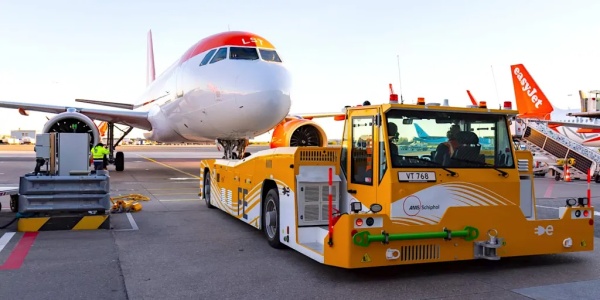
Amsterdam Schiphol Airport in the Netherlands has begun trial operations of the electric aircraft tug TaxiBot, which could sharply cut emissions generated during aircraft ground movements.
On June 9 local time, electric vehicle outlet Electrek reported that Schiphol Airport recently introduced TaxiBot, an electric aircraft towing system, and began verifying its performance in a real airport operating environment.
TaxiBot is a specialised electric tug that moves aircraft between the apron and the runway. It is designed to enable aircraft movement and power supply without operating the auxiliary power unit (APU) or main engines.
Airports typically use diesel tugs, or aircraft taxi to the runway by running their own engines and APU at low power. The process consumes significant fuel and creates emissions and noise. TaxiBot instead moves aircraft using battery power and supports taxiing to the runway while the pilot retains direct control of the aircraft.
Schiphol Airport expects the technology to cut carbon emissions generated during aircraft ground movements by more than 80 percent. Esme Valk (에스메 팔크), chief people and transformation officer at Royal Schiphol Group, said TaxiBot is a practical step to reduce emissions and noise on the apron. She said it will help create a healthier and cleaner working environment and contribute to building a future-oriented airport.
TaxiBot was jointly developed by Smart Airport Systems, TLD and Israel Aerospace Industries (IAI). Its biggest structural feature is that, rather than simply towing aircraft like conventional tugs, it supplies the power needed during movement while allowing the pilot to keep direct control. As a result, passengers are expected to experience less continuous noise from the APU at the tail, and ground-handling staff are also expected to reduce exposure to exhaust fumes.
Airlines are also focusing on fuel savings. William Pett (윌리엄 펫), easyJet's Netherlands and Scandinavia country manager, said TaxiBot is a technology that can immediately reduce fuel consumption, carbon emissions and ground noise. He said it was possible thanks to cooperation with ground-handling partners including Menzies Aviation.
TaxiBot is currently certified for the Airbus A320neo aircraft. Schiphol Airport is also pursuing certification for the Boeing 737 and plans to expand use by working with various airlines including Embraer aircraft operators, KLM Cityhopper and Transavia. The airport said it plans to add 3 more electric TaxiBots by the end of this year.
The industry sees TaxiBot as one of the key technologies in airports' decarbonisation strategies. Reducing the time aircraft engines and APUs are used can be expected to cut fuel costs and ease maintenance burdens. It is also assessed as helping improve efficiency in airport ground operations by enabling mobile power supply using large-capacity batteries.
Schiphol Airport plans to verify the real-world effects of electrified ground-handling equipment through the trial. With expanded aircraft certifications and additional equipment planned, attention is focused on whether electric tugs can become a new standard for airport ground operations.
 Jinju Hong
hongjj@d-today.co.kr
Jinju Hong
hongjj@d-today.co.kr