
[Digital Today Yoo Seung-a, intern reporter] Anthropic's publicly released Claude Fable 5 built video games and complex visualisation tools with a single prompt, setting a new benchmark in the AI coding race.
TechCrunch reported on June 9 that the model is the first public version in Anthropic's Mythos line.
The model is drawing attention for going beyond simple code assistance to keep working for hours based on lengthy specifications. Ethan Mollick (이선 몰릭), a University of Pennsylvania researcher and AI researcher, tested it and said Fable 5 "effectively outpaces almost all public models by a significant margin" among the public AI models he has used.
Mollick particularly praised its ability to sustain long work sessions. He said Fable 5 "showed strong capabilities across multiple problems and produced surprising results" and "kept working for up to 12 hours while executing specifications spanning several pages". That suggests it has strengths in long-running execution and composite tasks rather than simple question-and-answer exchanges.
A game-building demonstration drew attention. Mollick said he created multiple games through Claude Code using only a single initial prompt. Among them, "Snake" was implemented in a classic arcade style in which a character moves around the screen eating apples, and it was designed to end the game immediately if it moved off screen.
Another game, "Strata", was built around exploring an endlessly continuing underground tunnel while lighting a lantern. The graphics were not highly polished, but the key point was that a working game was generated from a single prompt. Mollick also created "Duino" based on a cycle of poems by German poet Rainer Maria Rilke. The game was structured so that moving a character through a night landscape brings lines of verse onto the screen.
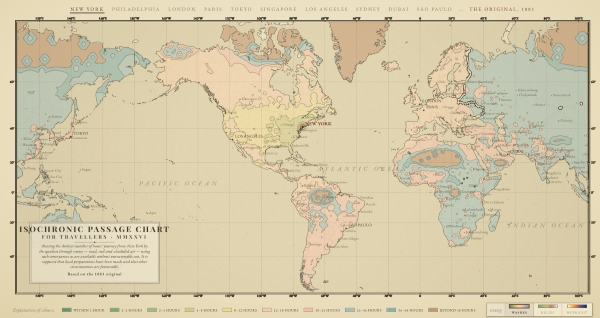
Use cases beyond games were also confirmed. Mollick used Fable 5 to create an isochrone map that visualised travel times between two points. The result showed a high level of completion in accuracy and detail.
The release is seen as an example of how quickly generative AI is compressing the software development process. In the past, games, mapping tools and complex specification-based projects required multiple developers, but now they are starting from a single prompt. It is not at a level that fully replaces developers, but analysis suggests it is sharply lowering barriers to entry in planning and prototyping.
Attention is now shifting to whether Fable 5 can reproduce the same level of performance in real development environments. The case shows that evaluation standards in competition among public AI models are expanding beyond simple code-generation ability to include long-running execution, specification interpretation and the completeness of outputs. The market is taking it as an example that the baseline for AI capabilities is rising quickly.
 Yoo Seung-a
ysah@d-today.co.kr
Yoo Seung-a
ysah@d-today.co.kr