
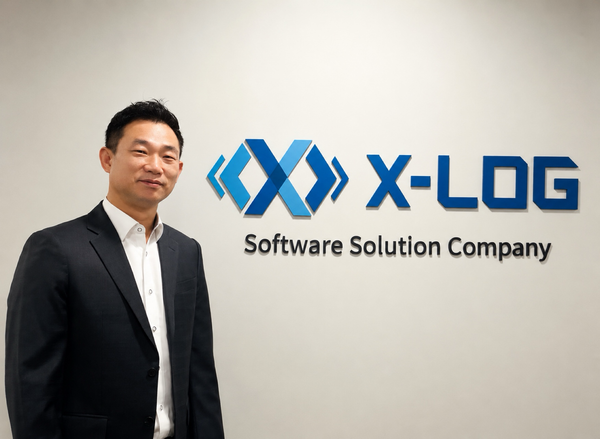
"Beyond data migration driven by database transitions, demand for real-time data replication solutions is also rising for integrating data for AI training and for disaster recovery systems. We will strengthen our competitiveness against global companies by emphasising speed and cost performance."
Xlog, which specialises in real-time data replication solutions, has set a goal of nearly 30 percent revenue growth this year. It expects revenue to reach 6 billion won this year from 4.5 billion won last year.
Jang Seok-ju (장석주), CEO of Xlog, said budgets allocated for disaster recovery (DR) have increased after a fire involving government resources, and demand is also rising for real-time data integration for AI training and for disaster recovery. He expressed confidence in meeting the target.
Real-time data replication centres on moving data elsewhere without shutting down the system. Because there must be no omissions during the transfer, it is seen as a field where it is difficult to secure customers without a high level of technical completeness. There are also not many players in the market. Overseas companies in the market include Oracle and Quest Software, while in South Korea, Xlog and TmaxSoft have entered the market.
Jang said real-time data replication must be applied without data loss even while a system is operating. He said the key is to replicate as quickly as possible without downtime. He said that in building a disaster recovery system, for example, benchmarks of 2 seconds or 3 seconds are set when replicating from Seoul to Busan, and CDC usually does not exceed 3 seconds. He added that no matter how fast it is, replication must be accurate and there must be no omissions.
Xlog’s main products are CDC and its data migration solution IDL (Initial Data Loader).
IDL is a solution that enables large volumes of initial data to be moved to a destination database at once. CDC (Change Data Capture) focuses on replicating changes in real time to the system to which data is being moved after the transfer. Users replicate to a new system without downtime and go through a rehearsal process before going live. Jang said a pre-rehearsal is essential when changing between heterogeneous databases.
According to the company, Xlog’s solutions focus on structured data, but also support replication and migration of file data among unstructured data. The company said its pricing is cheaper than foreign products and that it can cover data replication and migration work relatively quickly in heterogeneous database environments.
Jang said that unless a company is moving from Oracle to an Oracle database, there are many cases where using Xlog’s solution is faster. He said Xlog’s monitoring environment and user interface for administrators are also tailored to South Korean companies.
On pricing, he stressed that it is clearly cheaper than foreign products. He said data can become misaligned during replication, and in such cases a validator solution is needed to reconcile the data. He said Xlog provides a validator solution by default, while foreign vendors sell it separately.
Xlog has secured references among many leading South Korean companies, including a domestic global automaker. Jang said that among South Korean companies, demand is coming strongly from real-time linkage support for disaster recovery, data migration, and data moving back and forth between overseas sites and headquarters.
Xlog is also expanding its overseas foothold through K Global Hub, a Singapore-based partner active in Southeast Asia. Jang said the company began sales efforts 3 years ago and has seen results since last year. He said he expects revenue to reach a meaningful level this year.
Jang founded Xlog in 2014 on the conviction that demand for moving data in real time would increase. That conviction has not changed. He said that at the time of founding, he believed that as cloud, big data and AI spread, data would inevitably have to move in real time. He said it is slower than expected, but the direction will inevitably be toward real-time data replication. He said foreign vendors have a high market share, leaving plenty of room to target. He said many companies overseas moved to the cloud but are moving back to on-premises systems because of costs, and that this trend will stand out in South Korea as well, creating a new opportunity for Xlog.
 Hwang Chi-gyu
delight@d-today.co.kr
Hwang Chi-gyu
delight@d-today.co.kr