
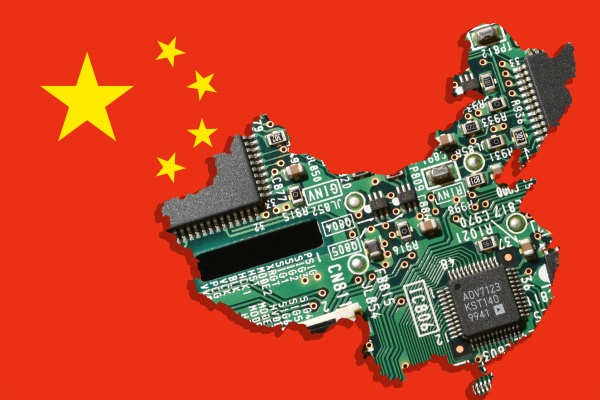
Major Chinese technology companies and state-backed investment institutions have launched a long-term investment fund worth 3.91 billion yuan (about 870 billion won) to respond to tighter U.S. technology export controls. The move is seen as aimed at providing long-term funding to China’s key technology industries, including semiconductors.
The South China Morning Post reported on June 9 that the new fund, the Changzhi Hanhai Private Investment Fund, was recently registered in Shanghai’s Pudong New Area. The fund aims to supply so-called patient capital to support R&D and commercialisation in deep-tech fields such as semiconductors.
Patient capital refers to long-term investment funding that reflects the nature of advanced technology industries, where it takes a long time to recover returns. Chinese authorities have recently continued to urge the financial sector to foster patient capital to support long-term R&D and technology commercialisation.
Both private technology companies and state-backed investment institutions took part as investors. The largest investor is Changxin Xinju Equity Investment Anhui, a subsidiary of Chinese DRAM chipmaker CXMT, holding 30 percent of total equity. Dongguan Trust, a Guangdong-based trust company, holds 29.4 percent, and the SSCI Leading Fund backed by Shanghai state-owned capital holds 20 percent.
Alibaba investment affiliate Hangzhou Haowei Enterprise Management is reported to hold 10.2 percent, and Chinese semiconductor equipment maker AMEC 7.7 percent.
The industry sees the fund’s launch as a signal of a shift in China’s semiconductor investment strategy. As U.S. export regulations on advanced semiconductors and equipment tighten, it is seen as a move to lower external dependence and build a long-term capital base for homegrown technology development.
China’s flagship semiconductor policy fund, the National Integrated Circuit Industry Investment Fund, known as the Big Fund, has recently been recalibrating its investment strategy. Regulatory filings show that the Big Fund has recovered at least 10 billion yuan this year by selling some stakes in mature companies including silicon wafer maker National Silicon Industry Group and foundry firm SMIC.
Among companies participating in the new fund, CXMT is drawing the most attention. CXMT, a leading Chinese DRAM maker, has continued to expand capacity and develop technology and received approval last month from the Shanghai Stock Exchange for an initial public offering worth 29.5 billion yuan. If the listing proceeds as planned, it is expected to be among the largest IPOs on the Chinese mainland this year.
Alibaba is also known as an early investor in CXMT. Alibaba Cloud and Alibaba China Network Technology jointly hold a 4.97 percent stake in CXMT. The fund participation is also seen as a move to maintain long-term involvement in investment in China’s core semiconductor supply chain and strategic technologies. CXMT, Alibaba and AMEC, among others, did not issue an official position on the fund.
The market sees the fund’s launch as an example showing China’s semiconductor industry is focusing on strengthening long-term R&D capabilities rather than short-term profits. It is also being analysed as a sign that the centre of China’s semiconductor investment ecosystem is being reshaped, as private companies and state capital created a new investment vehicle at a time when some state-led funds are being recovered.
 Jinju Hong
hongjj@d-today.co.kr
Jinju Hong
hongjj@d-today.co.kr