
KAIST has officially launched the Mind Care & Growth Center, integrating mental health support for university members. It expanded and reorganised its existing counseling center, combining psychological counseling, mental health care and crisis support into one system.
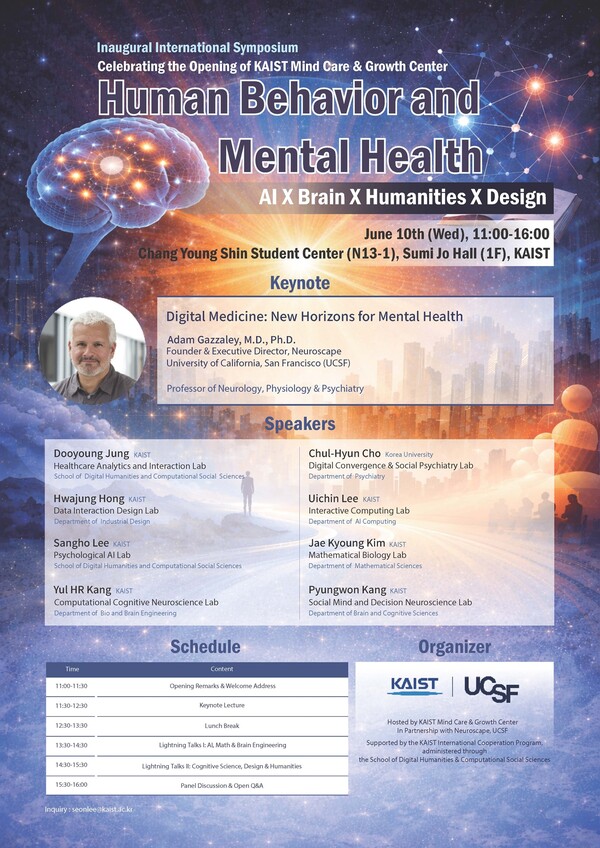
KAIST will hold an international symposium titled "Human Behavior and Mental Health" on June 10 to mark the launch. The event will take place at the Cho Su-mi Hall at the Jang Young-shin Student Center on its main campus in Daejeon.
The center integrates counseling, care and crisis support functions that had been scattered across the campus. Its core goal is to link counseling, care and crisis support services to provide consistent support.
It aims to go beyond a simple counseling support organisation and become a converged platform combining hands-on mental health experience with KAIST research capabilities. Researchers across fields including artificial intelligence (AI), brain science, design, humanities and social sciences, mathematics and computer engineering will take part in digital mental health research, and the institute plans to refine mental health services based on the results.
The launch symposium will be attended by KAIST professors, researchers and students, along with experts in digital mental health. They will discuss support systems for members' mental health and future directions for digital-based mental health research.
The keynote speech will be delivered by Adam Gazzaley (애덤 가잘리), a professor and founder of Neuroscape, a digital brain health research center at the University of California, San Francisco (UCSF). In the following sessions, KAIST faculty members from fields including mathematics, brain engineering, AI, computer engineering, design, and humanities and social sciences will present future research directions through lightning talks. They will also discuss ways to cooperate globally with Neuroscape.
The center will pursue related research along with mental health support. Center head Doo-young Jung (정두영) recently published joint research with Cheol-hyun Cho (조철현), a professor in the Department of Psychiatry at Korea University College of Medicine, analysing the impact of generative AI on mental health care settings.
The study analysed real clinical experiences of 311 psychiatrists in South Korea. It suggested that generative AI could help with organising emotions, self-management and improving access to treatment, but depending on the context of use it could lead to overreliance, reinforcement of distorted beliefs and side effects in high-risk situations.
Jung said, "A healthy mind must be the foundation for excellent research outcomes." He added, "We will develop the Mind Care & Growth Center into a platform that leads university mental health solutions."
 Jin-ho Lee
jhlee26@d-today.co.kr
Jin-ho Lee
jhlee26@d-today.co.kr