
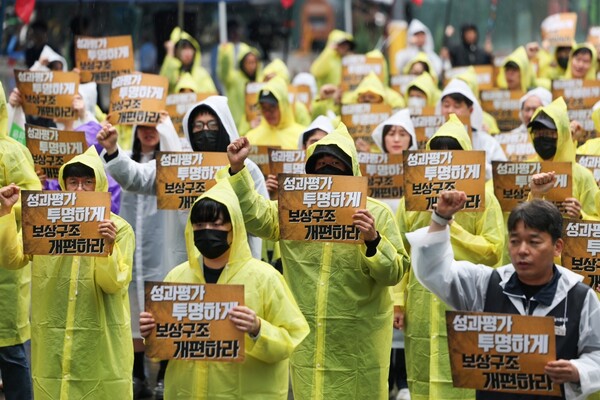
The Kakao branch of the Korean Federation of Chemical, Textile and Food Industry Trade Unions will begin a partial strike at 10 a.m. on Tuesday, the first such action at Kakao's headquarters since the company was founded. Four affiliates including Kakao Pay, Kakao Enterprise, DK Techin and XL Games will also take part, with five entities carrying out the strike jointly.
The partial strike will run from 10 a.m. to 3 p.m., and the effective strike time is 4 hours excluding a 1-hour lunch break. The union will also hold a rally and march from 11:30 a.m. to 12:30 p.m. around Pangyo Agit. The march is expected to cover about 800 metres from in front of Pangyo Agit to U-Space. The number of participating members is estimated at about 600.
The direct cause of the strike is the breakdown of wage negotiations. Labour and management attempted a second mediation at the Gyeonggi Labour Relations Commission on May 27 but failed to reach an agreement, securing the right to strike for unions at the five entities. A membership vote also ended with approval of the strike plan. After the strike date was made official, the two sides held one additional round of talks at the headquarters level but failed to narrow differences.
The core issue is how to allocate performance bonuses. The union is seeking performance pay equivalent to 13 to 15 percent of last year's standalone operating profit and argues that restricted stock units worth 5 million won should be paid separately from performance pay. Kakao has paid RSUs since last year to employees with 1 year of service, and the union says they should not be included in the performance pay pool. Management, by contrast, proposed including RSUs in performance compensation, and the union explained that in that case total performance compensation would be limited to about 10.5 percent of operating profit.
The union says it is challenging the management-centred compensation structure, beyond a simple demand for higher wages. In Kakao Pay's case, it raised fairness concerns in performance distribution, saying compensation normalisation for members was not sufficiently carried out even after it returned to profitability last year. It also listed as key demands the removal of employment insecurity factors such as sales, spinoffs and restructuring, and holding executives accountable for decision-making.
Since confirming the strike date, the union has stepped up pressure by issuing daily statements over 9 days targeting management at each participating entity. It described the departure of former Kakao chief product officer Min-taek Hong (홍민택) as an "avoidant exit" and publicly held management at Kakao Enterprise and Kakao Pay responsible for the breakdown in negotiations. The union said it plans to gradually escalate the level of strike action depending on how talks proceed after the partial strike begins.
Management says the union's demands would burden the company's capacity for future investment and efforts to boost shareholder value. Kakao said in a public statement on May 29, "Performance compensation for crew members should take into account capacity for future investment and efforts to boost shareholder value, and should be balanced at a sustainable level."
The government is also watching the strike closely. The Ministry of Science and ICT held an emergency inspection meeting with Kakao on June 8 to discuss ways to ensure stable operation of major digital services such as KakaoTalk and KakaoMap and a rapid response system in case of disruptions. The two sides agreed to keep a cooperative system in place to continuously monitor service operations and to swiftly share information and respond in the event of disruptions.
The industry sees a low possibility that the strike will directly lead to service disruptions. That is because essential operational staff are being maintained and major service systems are automated, given the nature of the IT industry.
Kakao said, "As a platform company that connects the daily lives of countless users and supports the businesses of small merchants and partners, it is Kakao's important responsibility to maintain service stability so there is no inconvenience to users under any circumstances. The company will have the necessary response system in place and do its best to operate services stably."
 Hojeong Lee
lhj@d-today.co.kr
Hojeong Lee
lhj@d-today.co.kr