
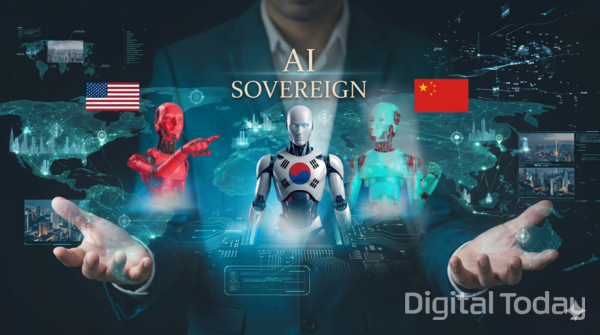
[DigitalToday reporter Seulgi Son] South Korea's competitiveness in artificial intelligence (AI) technology depends heavily on overseas providers across all areas, from semiconductors and accelerators to application software, making full-stack self-reliance impossible in the short term, an assessment showed.
The Korea Information Society Development Institute (KISDI) recently published a report titled "AI technological sovereignty and measures to enhance national competitiveness" and recommended "resetting strategic goals toward minimum dependence and maximum competitiveness, and investing 집중 in AI models and cloud in the short term."
The report was based on a survey of 38 AI technology experts. Respondents came from companies, academia, public institutions and investment consulting across the AI technology stack, with AI model experts the largest group at 21. They rated nine major AI technology stacks on overseas dependence, supply chain risk, current competitiveness and future competitiveness on a five-point scale.
Overseas dependence was tallied in the order of semiconductors and accelerators (4.93), development platforms and frameworks (4.81), system software (4.50), networks (4.43), cloud (4.33) and AI models (4.00). Six stacks, excluding data infrastructure and solutions (3.00) and application software (2.88), recorded "high" overseas dependence at 4 points or above. The report said U.S. companies wield monopolistic influence in nearly all AI technology stacks, and the result aligns with conclusions that can be drawn from global competition conditions.
For semiconductors and accelerators in particular, the report pointed to Nvidia GPU dominance and a structure dependent on TSMC packaging. For system software, it cited an absolute monopoly structure in Nvidia CUDA and NCCL, while development platforms were assessed as effectively dominated by Meta's PyTorch. One expert who took part in the survey said the global AI development stack depends absolutely on U.S.-led open-source frameworks based on CUDA, PyTorch and LangChain, and even if domestic NPUs are developed, they ultimately must remain dependent on this overseas ecosystem.
Supply chain risk was also "average" (3 points) or higher in most items. It was 4.15 for semiconductors and accelerators, 3.80 for system software, 3.50 for cloud and 3.36 for AI models. Development platforms and frameworks, however, had supply chain risk of 2.63 because they are open source.
Current competitiveness was below 3 points, the "average" level, across all stacks. AI models (2.61) and cloud (2.58) ranked relatively high, while development platforms and frameworks had the lowest competitiveness at 1.69.
◆"Goals must shift to minimum dependence and maximum competitiveness"
Based on the assessment, the report called for a shift in policy goals. It stressed that technical self-reliance across all AI technology stacks is not the only way to secure AI technological sovereignty. Given that the current AI ecosystem, effectively dominated by the United States, has seen technology stacks interconnected and co-evolve, it judged that full-stack technical self-reliance is not a goal that can be achieved in the short term.
It also warned of the risks of forcing adoption of an independent technology stack. The report said adopting an independent technology stack that is detached from the global market could lead to lower efficiency in using technology and limited market demand, and stressed it would be difficult to secure competitiveness in GPU-based cloud AI and general-purpose large language models (LLMs) without participating in the Nvidia ecosystem.
As an alternative, it presented "minimum dependence and maximum competitiveness." If complete self-reliance is impossible, it said autonomy should be secured at least in core technology fields so it is not swayed by external pressure.
◆"In the short term, focus on AI models and cloud; in the mid to long term, on semiconductors and system software"
Policy priorities were derived by cross-analyzing supply chain risk and future competitiveness by technology stack.
AI models, with high supply chain risk and high future competitiveness (3.30), and cloud (3.42) were classified as areas for 집중 investment in the short term. The report stressed that securing competitiveness in the data and AI model training ecosystem should take priority.
Semiconductors and accelerators, with high supply chain risk but low future competitiveness (2.50), and system software (3.00) were presented as mid- to long-term tasks. Experts judged that the government should continue to respond to supply chain risks but that it would be difficult to expect short-term results.
It presented six specific implementation strategies: narrowing the global gap in large-scale AI models and designing an ecosystem for mutual development of general-purpose and domain models; securing integrated competitiveness linking independent AI models with NPUs and HW-SW; demand-based self-sustaining growth by revitalising the AI service ecosystem; fostering "vertical AI" and "physical AI" linked to strategic industries; strengthening AI governance; and building a challenging research ecosystem.
In the expert survey, the highest agreement score (4.32) was for the policy direction that the government should concentrate resources on core technology stacks where South Korea can be competitive. The most-cited next-generation promising markets were industry-specialised AI (25 respondents), physical AI (22) and AI agents (21).
The report said the government's current direction of securing GPUs in bulk and supporting development of independent foundation models overlaps in some respects, but lacks clear goals and a roadmap.
Some in the industry point out that policy should put more weight on securing autonomy. One AI industry official said South Korea has secured its own competitiveness in hardware only in DRAM, and that rather than trying to localise all design, development and production already dominated by Nvidia or TSMC in the short term, it is more realistic to broaden the scope of participation in the value chain by using its memory advantage.
Another official said technological sovereignty should not be defined as technical self-reliance, and that even if using the Nvidia stack, South Korea should find feasible ways to secure autonomy, such as developing alternative options for core workloads.
 Seulgi Son
sageson@d-today.co.kr
Seulgi Son
sageson@d-today.co.kr