
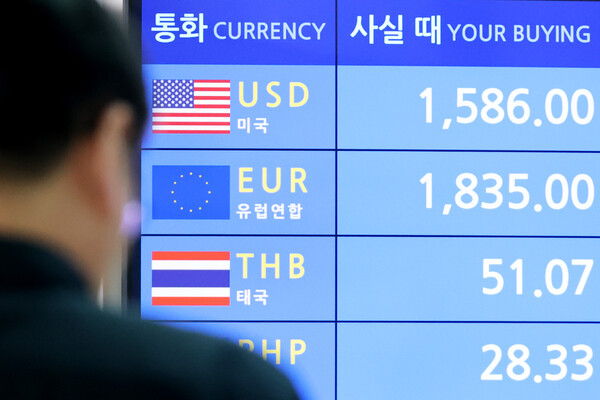
The won-dollar exchange rate has surged to the 1,560 level, heightening instability in the foreign exchange market. The spike has eased for now after authorities’ verbal intervention and the National Pension Service resumed currency hedging. But caution over U.S. monetary policy, Middle East risks and foreign selling of stocks continue to pressure the won. Financial sector officials say the near-term ceiling may be limited, but exchange-rate volatility could persist for the time being.
As of June 10, the won-dollar rate recently jumped to the 1,560 level in intraday trading, reaching its highest level since the financial crisis, the financial sector said. As the rate climbed sharply over a short period, the foreign exchange market even discussed the possibility of a move past 1,600.
Market participants cite caution over U.S. monetary policy, uncertainty in the Middle East, net selling by foreigners in South Korea’s stock market and one-way positioning through offshore non-deliverable forward (NDF) trading. Adjustments by exporters and importers in the timing of payments are also cited as adding to upward pressure on the exchange rate.
Foreign exchange authorities have moved to stabilise the market. The Financial Services Commission held a "banking sector meeting on the foreign exchange market" on June 8 to review conditions. Authorities said they would closely watch the possibility of speculative one-way positioning through offshore NDF trading and would respond strictly to market-disrupting activity. They also plan to review institutional improvements that could absorb offshore NDF trading into the onshore foreign exchange market.
Lee Hyeong-ryeol (이형렬), director general of the international finance bureau at the Ministry of Economy and Finance, stressed that authorities would never tolerate excessive volatility and one-way positioning and would respond strongly.
The Financial Services Commission also said it would take strict measures depending on the results of inspections into speculative moves. It urged banks to strictly comply with their code of conduct in the foreign exchange market and to strengthen internal controls to prevent market disruption.
The National Pension Service resumed currency hedging, shifting market sentiment. As it became known that the pension fund had sold forward contracts to reduce exchange-rate risk on overseas assets, the market interpreted this as possibly reflecting the fund’s view of the upper bound for the exchange rate in the high 1,550s. Because the fund’s hedging can have an effect similar to authorities’ direct intervention, it reinforced perceptions that the won-dollar rate had reached a short-term peak.
The won-dollar rate has since retraced part of its gains. In New York, the won-dollar rate ended at 1,526.5, down 12.6 won from the previous session’s closing level in the Seoul foreign exchange market. In Seoul on June 9, the won-dollar rate opened at 1,529, down 5.6 won from the previous trading day, and ended at 1,512.1, down 22.9 won.
SHORT-TERM CEILING LIMITED, BUT UPSIDE FACTORS REMAIN
The market sees the actions by authorities and the National Pension Service as potentially limiting the exchange rate’s upside. Lee Yu-jeong (이유정), a researcher at Hana Bank’s FX and derivatives sales department, said risk aversion in the market has eased somewhat as military tensions in the Middle East have softened under U.S. mediation. She expects the won-dollar rate to face downward pressure as the dollar’s steep strengthening trend has paused.
She said the upper resistance line has strengthened given authorities’ demonstrated willingness to stabilise the market, and selling by exporters based on peak-level perceptions could also weigh on the rate. But she said the lower end is likely to be supported as foreigners’ net selling in the local stock market continues.
She said the recent surge in the exchange rate was the result of external negatives combining with domestic stock market moves. Middle East risks and worries about tightening by the U.S. Federal Reserve added to won weakness, while foreign rebalancing sales after a short-term jump in the KOSPI were amplified and reflected in the FX market, she said.
She said the active response by authorities and the National Pension Service to stabilise the FX market is seen as a timely step aimed at steadying the won’s exchange rate and easing the shock to the economy. She said it is also expected to play a positive role in curbing one-way positioning and expectations of further rises in the exchange rate.
She added that, with authorities’ strong willingness to stabilise the exchange rate now confirmed, the near-term ceiling is unlikely to surpass the previous peak unless external conditions worsen further.
Others urged caution, saying upside drivers for the exchange rate remain. With foreign selling of domestic stocks continuing, uncertainty over the Middle East conflict, the burden of high oil prices and next week’s meeting of the U.S. Federal Open Market Committee (FOMC) could all act as upward pressure.
Lee Min-hyeok (이민혁), an economist at KB Kookmin Bank, said expectations of a high exchange rate have strengthened further among domestic FX market participants, and some are even discussing the possibility of reaching 1,600. The problem is that factors that could still push the exchange rate higher remain, he said.
He said uncertainty over the Middle East conflict, the burden of high oil prices and next week’s FOMC, along with continued foreign selling of domestic stocks, could all add upward pressure. If strong U.S. employment data are followed by this week’s consumer price index (CPI) coming in higher than expected, the Fed could turn more hawkish, which could further stir expectations of a high exchange rate, he said.
Still, he said the high exchange rate is unlikely to become entrenched for a long period. The current high exchange rate is unlikely to persist for long, he said, because foreign stock selling cannot continue indefinitely and fundamentals such as the South Korea-U.S. interest rate gap and an improving trade balance are favourable for the won.
Even if the exchange rate passes a short-term peak, volatility could increase the burden of risk management for financial holding firms and banks. If dollar funding conditions become unstable, banks’ management of foreign currency liquidity and the cost of rolling over foreign currency bonds could rise. If costs rise for companies with high reliance on imported raw materials and energy, that could also weigh on the soundness of corporate lending.
Some also said that if exchange-rate instability widens again, the intensity of monetary policy responses could rise. As won weakness can push up import prices, analysts say the Bank of Korea could move to stabilise the market with a "big step" if the exchange rate spike spreads into inflation instability.
Choi Ji-uk (최지욱), a researcher at Korea Investment & Securities, said that if the exchange rate approaches around 1,600 after breaking past the peak of 1,561 despite various FX policy measures, the possibility of a 50 basis-point rate hike should be left open to prevent excessive one-way positioning and limit spillover effects on prices.
 Ji-young Lee
ljy@d-today.co.kr
Ji-young Lee
ljy@d-today.co.kr