
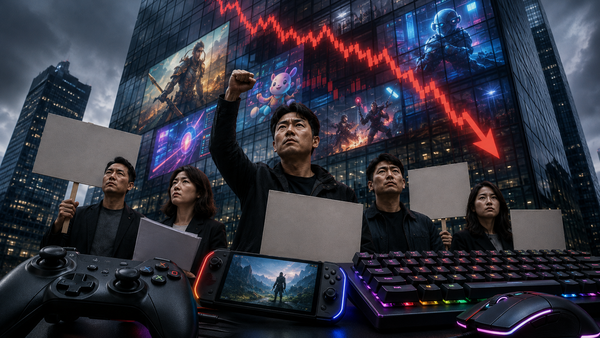
Collective action by retail shareholders is continuing in the game industry. With weak share prices dragging on, and demands to improve shareholder value growing, discontent among individual investors is taking shape in stake-building and the submission of formal demands.
According to the industry on Tuesday, retail shareholders in major game companies such as Pearl Abyss, Devsisters and Wemade have recently called for shareholder meetings, buybacks and cancellation of treasury shares, limits on executive pay and disclosure on the development status of new titles. Complaints once aired as one-off outbursts at annual meetings are turning into organised action, including stake-building, formal demands, and filing notices for rallies.
Pearl Abyss discloses corporate value plan ahead of rally; first-ever dividend and treasury share cancellation
With a retail shareholder group at Pearl Abyss planning a rally on Tuesday, Pearl Abyss filed disclosures after the market closed on Monday on a plan to improve corporate value and a decision to cancel treasury shares. The company presented its first dividend policy since founding, and decided to pay annually the larger of 10 billion won and 10 percent of net profit. It also said it will cancel 1,403,945 shares, equal to half of its treasury stock holdings of 4.4 percent, worth about 54 billion won based on the previous day's closing price, on Thursday. It also announced plans to buy an additional 100 billion won worth of treasury shares in the second half.
According to the retail shareholder group, the disclosures effectively reflected nearly all key demands the group had sought to put on the agenda for an extraordinary shareholders' meeting. These included a larger dividend, cancellation of existing treasury shares, a 100 billion won treasury share buyback and cancellation, stronger institutional investor relations and disclosure of the roadmap for the next title. The nature of the Tuesday rally has therefore changed. It was planned as a protest urging a lift in the share price and stronger communication, but will instead proceed with banners carrying messages of support in response to the company's moves.
Shareholder discontent stemmed from the stock's performance since the release of new title "Crimson Desert". The shares rose as high as 77,400 won intraday on April 1, the highest level in about 4 years, but the closing price on Monday was 38,600 won, about half the peak. With progress on the next titles "DokeV" and "Plan 8" not clearly materialising, market expectations had also weakened.
As of Monday, the consolidated stake stood at 4.99 percent. Under commercial law, shareholders who secure a certain stake can exercise minority shareholder rights such as calling an extraordinary shareholders' meeting, leaving the company with little choice but to take shareholder demands into account. Pearl Abyss said it is coordinating an internal schedule to hold a shareholder meeting in July.
Devsisters moved after retail shareholders united; CFO to host meeting
Devsisters also decided to hold a shareholder meeting in response to pressure from retail investors. Devsisters will hold a meeting on Thursday hosted by Chief Financial Officer Sung-taek Lim (임성택). The decision came as a retail shareholder group was preparing to send a shareholder letter in the form of a certified notice.
The stake consolidated by Devsisters retail shareholders through Act is currently 7.06 percent. That is more than double the 3 percent threshold under commercial law for requesting an extraordinary shareholders' meeting. Retail shareholders have also warned they could seek to appoint an auditor through an extraordinary meeting, leaving the company unable to dismiss the demands lightly.
At Devsisters, weak performance of new titles and worsening results were the direct backdrop to shareholder action. The mobile action game "CookieRun: OvenSmash" based on the CookieRun intellectual property, released in March, fell short of expectations, sending the stock lower and spreading calls, led by retail shareholders, for management accountability. The shares are down 57 percent from the start of the year.
As shareholder backlash intensified, the company also announced tougher steps. Chief Executive Gil-hyun Cho (조길현) and board co-chairs Ji-hoon Lee (이지훈) and Jong-heun Kim (김종흔) decided to forgo their full salaries until management stability is secured. Pay for key executives will also be cut by 50 percent. The company will set up a cost management task force reporting directly to the CEO and will push for voluntary retirement across the company and a temporary freeze on new hiring.
Devsisters will also review its game and IP business portfolio with profitability and growth in mind. In response to criticism that it relies heavily on the CookieRun IP, it plans to focus resources on key titles and IPs with tangible results, and to strengthen business feasibility checks for new projects. Retail shareholder demands have expanded beyond complaints over the share price to issues of business structure, cost control and management accountability.
Wemade shareholders visit headquarters with "12 key demands"
Wemade retail shareholders opted for a more direct approach. Shareholder representatives visited Wemade's headquarters in Seongnam, Gyeonggi Province on June 2 and formally delivered "12 key demands" to executives. The demands included buying back and cancelling at least 3 percent of treasury shares, disclosing the development status of the new title "Night Crows 2", and limiting increases in executive salaries and bonuses through 2027. They also requested meetings and an AMA (Ask Me Anything) session to communicate directly with management.
Wemade said in a corporate value plan disclosure on March 24 that it would allocate 10 billion won in cash dividends or 20 percent of consolidated operating profit as funds for shareholder returns. Shareholders, however, are calling for more direct measures to lift the share price, including cancellation of treasury shares. Dividends are largely cash returns, while cancelling treasury shares reduces the number of shares in circulation and raises per-share value, and shareholder demands are seen as focusing on expected effects on the share price.
Wemade shares closed at 17,020 won on Monday, down 36 percent from the start of the year.
Wemade also faced criticism from retail shareholders at its regular annual meeting in March. After the meeting ended, CEO Kwan-ho Park (박관호) held an impromptu session for about 1 hour and 20 minutes and said, "This year, the scale of profits will increase further," adding, "We will enhance competitiveness through innovation in game development using AI."
Broader pressure on game industry for shareholder returns
The companies share a common thread of weakened market trust in game stocks. Pearl Abyss answered shareholder pressure with a corporate value plan. At Devsisters, weak new title performance and deteriorating results spread into calls for management accountability. At Wemade, demands for stronger buybacks and treasury share cancellations than dividends have come to the fore amid a prolonged share price decline.
As market funds concentrated in the semiconductor and AI sectors, game stocks were relatively sidelined due to uncertainty over new title success, slowing growth in live services and cost burdens. As calls to expand shareholder returns grew, particularly among mid-sized game companies, some companies moved preemptively. Webzen announced a shareholder return policy worth 90 billion won, about 20 percent of its market capitalisation this year. Com2uS decided to cancel treasury shares equal to 5.1 percent of outstanding shares and approved a 14.8 billion won cash dividend. Neowiz also unveiled a mid- to long-term policy to return 20 percent of consolidated operating profit over the three years from 2025 to 2027.
Retail shareholder moves in the game industry could continue for the time being. If new title performance is not reflected in share prices or business uncertainty is not resolved, shareholders could use institutional tools beyond demands for meetings, including shareholder proposals and calls for extraordinary shareholders' meetings. Game companies face a situation in which they must examine not only new title development and performance improvement, but also disclosure, capital policies and frameworks for responsible management.
An industry official said, "In the past, it was at the level of airing complaints at shareholders' meetings, but now there is a structure in which shares are gathered through platforms and lead to the actual exercise of shareholder rights." The official added, "It has become an era in which game companies must pay as much attention to shareholder communication and capital policy as to performance and new titles."
 Hojeong Lee
lhj@d-today.co.kr
Hojeong Lee
lhj@d-today.co.kr